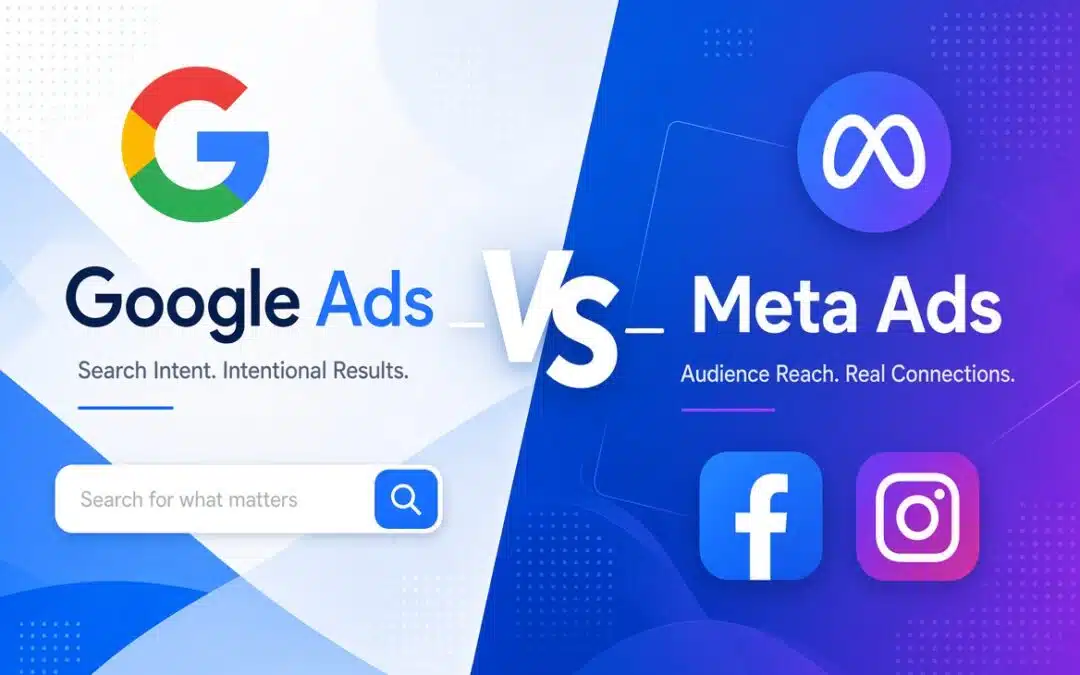
If you’re a local service business in Southwest Florida—or anywhere—you’ve probably asked: Should I put my ad budget into Google Ads or Meta Ads (Facebook + Instagram)?
The short answer: They serve different jobs. Google Ads captures people who are already searching for what you offer. Meta Ads creates demand by putting your business in front of people who aren’t actively looking yet.
Understanding the difference helps you stop wasting money and start generating more qualified leads.
The Core Difference: Intent vs. Discovery
Google Ads is demand capture. Someone types “emergency plumber near me,” “AC repair North Port,” or “stormwater management Sarasota” into Google. They’re already in the market. Your ad shows up at the exact moment of need.
Meta Ads is demand creation. People are scrolling Facebook or Instagram. They’re not searching for a plumber—they’re looking at photos, videos, and Reels. Your ad interrupts that scroll with a relevant visual or offer and plants the idea.
This single distinction drives almost every other difference in cost, conversion rate, and strategy.
Side-by-Side Comparison (2026 Benchmarks)
| Factor | Google Ads | Meta Ads (Facebook/Instagram) |
|---|---|---|
| User Intent | High – actively searching | Low to medium – browsing/scrolling |
| Best Funnel Stage | Bottom (ready to buy/call) | Top & mid (awareness & consideration) |
| Primary Targeting | Keywords + search intent | Interests, behaviors, demographics, lookalikes |
| Ad Formats | Text search, Shopping, Display, YouTube, Performance Max | Image, video, Reels, Stories, carousel, collection |
| Average CPC (approx.) | $4–$6+ (higher in competitive niches) | $0.70–$1.50 (traffic); higher for leads |
| Typical Conversion Rate | Higher (often 6–8%+ on Search) | Lower (often 1–2%) |
| Speed to Results | Faster (days) | Slower (learning phase of 1–2+ weeks) |
| Best For | Local services, high-intent leads, B2B | Visual products, brand awareness, e-commerce |
Sources for benchmarks include industry reports from WordStream/LocaliQ and other 2026 analyses. Actual numbers vary significantly by industry and competition.
When Google Ads Wins
Google Ads shines for:
- Local service businesses (plumbing, HVAC, roofing, electrical, landscaping, legal, medical)
- High-intent “near me” searches
- Faster lead generation and phone calls
- Situations where lead quality matters more than volume
Someone searching “AC not cooling North Port” is far more likely to call today than someone who sees a Facebook ad while scrolling.
Performance Max and Search campaigns also let you appear across Google Search, Maps, YouTube, and the Display Network from a single campaign.
When Meta Ads Wins
Meta Ads performs better when:
- Your offer is highly visual
- You need to build awareness or educate the market
- Search volume for your service is low
- You’re running retargeting or nurturing warm audiences
- You sell products that people discover rather than actively seek
Meta’s Advantage+ automation and creative testing tools make it strong for top-of-funnel brand building and e-commerce. Costs per click are typically much lower, but conversion rates are also lower because the audience isn’t as ready to buy.
The Smart Approach Most Businesses Should Use
Most Southwest Florida service businesses get the best results by using both—strategically:
- Use Google Ads to capture high-intent searches and drive immediate calls/leads.
- Use Meta Ads to stay top-of-mind, retarget website visitors, and build brand recognition so more people eventually search for you (or your competitors).
This creates a full-funnel system. Meta warms the audience. Google converts them when they’re ready.
Practical Tips for Local Businesses
- Start with Google if people already search for your service (most trades and professional services).
- Add Meta once you have conversion tracking, a solid website, and some budget for testing creatives.
- Always track phone calls, form fills, and booked jobs—not just clicks.
- Landing pages matter on both platforms. A fast, mobile-friendly site with clear calls-to-action improves results everywhere.
- Pair paid ads with strong local SEO and Google Business Profile optimization so you rank organically too.
At US Web Central, we help local businesses build the foundation (AI-optimized websites + local SEO) that makes both Google and Meta campaigns more profitable. A poorly converting website wastes ad dollars on either platform.
Ready to Get More Qualified Leads?
If you’re unsure where to allocate your next advertising dollar—or your current campaigns aren’t delivering—reach out. We can review your situation and help you decide the right mix of Google Ads, Meta Ads, and organic visibility for your market.
Contact us for a free consultation or website audit.
Frequently Asked Questions
What is the main difference between Google Ads and Meta Ads?
Google Ads targets people actively searching for solutions (high intent). Meta Ads targets people based on interests and behaviors while they scroll social media (discovery).
Which is cheaper: Google Ads or Meta Ads?
Meta Ads usually has lower cost-per-click. Google Ads often has higher cost-per-click but stronger conversion rates and lead quality, especially for service businesses.
Which platform is better for local service businesses in Florida?
Google Ads is typically the stronger starting point for plumbers, HVAC companies, roofers, and similar trades because of high “near me” search intent. Meta works well as a supporting channel for awareness and retargeting.
Can I run both Google Ads and Meta Ads at the same time?
Yes—and most successful businesses eventually do. Use Google for bottom-funnel conversions and Meta for top- and mid-funnel awareness and retargeting.
How much budget do I need to start?
You can test Meta with smaller daily budgets. Competitive Google Search campaigns in local service niches often need more to generate meaningful data and results. Consistent monthly budgets perform better than sporadic spending on both platforms.
Do I need a good website for these ads to work?
Yes. Both platforms send traffic to your site (or landing pages). A slow, unclear, or non-mobile-friendly site kills conversion rates and wastes budget.
Should I manage Google and Meta Ads myself or hire help?
Both platforms have learning curves and require ongoing optimization, creative testing, and tracking. Many local businesses get better results by partnering with an agency that understands local markets and can manage campaigns alongside SEO and website performance.