

Facebook ads work for contractors when they do one job: put a clear offer in front of homeowners in your service area and make it easy to ask for an estimate. They work best alongside a fast website and a strong Google Business Profile, because a homeowner who sees your ad will usually look you up before calling. Below is how to choose a goal, target your area, build ads people respond to, follow up on leads and measure what the ads earn you.
Key Takeaways
- Pick one goal per campaign. For most contractors that is lead generation, aimed at homeowners inside your actual service area.
- Ads need a landing path that works: a short form or a fast page, plus a call back within minutes, not days.
- Judge ads by booked jobs and revenue, not by cost per lead alone.
- If ads aren’t producing leads, check the offer, the audience, the form and your follow-up speed before raising the budget.
- Facebook ads create demand. Google, Maps and your website capture the people who go looking for you afterward.
Table of Contents
- When Facebook Ads Make Sense for a Contractor
- Start With One Goal and the Matching Objective
- Know Who You Are Talking To
- Build Creative for the Feed
- Build a Lead Path That Protects Your Time
- Set a Budget You Can Learn From
- Measure Booked Jobs, Not Just Leads
- Why Facebook Ads Stop Generating Leads
- Our Perspective
- Get Your Ads, Website and Local Search Working Together
- FAQ
- Sources
When Facebook Ads Make Sense for a Contractor
Search ads catch people who already need a roofer or an AC tech today. Facebook ads reach people who haven’t started looking yet. That makes them useful in a few situations:
- You want to fill a slow season with projects like remodels, roof replacements, repaints, pavers or pool enclosures.
- You want to reach homeowners in specific neighborhoods, not an entire metro area.
- You have strong project photos and video that show your work better than a text ad can.
- You run seasonal offers, such as an AC tune-up before summer or a hurricane-season roof inspection.
ServiceTitan’s guide to contractor Facebook ads makes the same basic case: the platform lets you reach homeowners in your service areas, control spend and turn interest into booked jobs. In Southwest Florida, where neighborhoods differ a lot from Sarasota to Port Charlotte to Cape Coral, that precision is a real advantage.
Facebook is weaker for pure emergencies. Someone with a dead AC in August searches Google. If you do both emergency and planned work, run Facebook for planned work and let search and Maps cover the emergencies. Our comparison of Google Ads vs Meta Ads goes deeper on which platform fits which job.
Start With One Goal and the Matching Objective
Facebook asks you to choose a campaign objective first. According to ServiceTitan, the options include lead generation, traffic, brand awareness, engagement, conversions and video views. For contractors, three matter:
| Objective | Use it when | What you get |
|---|---|---|
| Leads | You want estimate requests without sending people to your site | Instant forms with contact details |
| Traffic | You have a strong landing page for a specific service | Visits to a page you control |
| Awareness | You are entering a new town or launching a new service | Reach, not direct inquiries |
If you are new to ads, start with leads. Don’t mix goals. A campaign that tries to collect likes, drive clicks and book estimates at once usually does none of them well.
Lead ads vs. sending people to your website
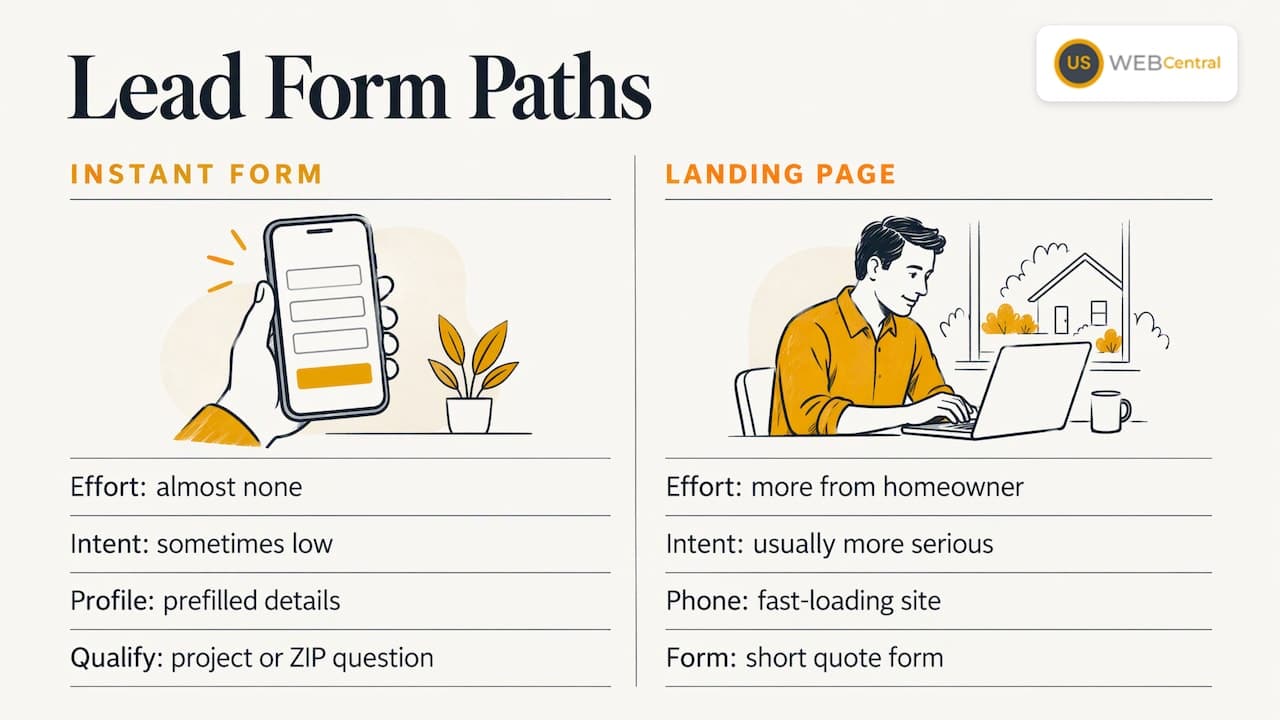
Meta describes lead ads with instant form as a way to collect contact details from interested people through a form, and the forms can pre-fill information from the person’s profile. That is easy for a homeowner on a phone. The tradeoff is intent: it takes almost no effort to submit, so you will get some people who barely remember doing it. Add a question or two that qualifies them, such as the type of project or the ZIP code, and you will spend less time on calls that go nowhere.
Sending people to a landing page asks more of them, but the people who fill it out are usually more serious. If your site loads quickly on a phone and has a short quote form, test both paths against each other.
Know Who You Are Talking To
Targeting is where contractors waste the most money. Instead of drawing a circle around a whole county, build the audience around where you actually work and who actually buys.
- Location: ServiceTitan recommends targeting by ZIP code, city or neighborhood. If you serve Sarasota, North Port and Punta Gorda but not Fort Myers, exclude Fort Myers.
- Homeowners: Layer in homeownership and age ranges that fit your typical job. A roof replacement buyer and a handyman customer are not the same person.
- Job size: Small repair work and large remodels need different audiences and different offers. Keep them in separate ad sets so you can see what each costs.
- Existing customers: Upload past customer lists, where Meta’s rules allow it, to find similar people and to ask for referrals.
Keep it local. A tight audience of a few ZIP codes in Sarasota County will teach you more than a broad audience spread across three counties.
Build Creative for the Feed
People scroll Facebook fast. Your ad has a second or two to look like something worth stopping for. ServiceTitan’s recommendations for contractor creative boil down to five things: sharp photos or video, short copy that leads with the benefit, a compelling offer, a clear call to action and social proof.
Here is how that looks in practice:
- Show real work. A before-and-after of a finished bathroom, roof or paver driveway beats a stock photo every time. Use your own crews and your own jobs.
- Lead with the result. “A new roof before hurricane season” says more than “Quality roofing services.”
- Make an offer. A free estimate is the minimum. Seasonal offers, such as a spring AC tune-up or a free roof inspection, give people a reason to act now.
- Add proof. A short customer quote, a review rating or a project name from the neighborhood builds trust quickly.
- One clear action. “Request your estimate” is better than three buttons.
Three ad ideas to adapt
- Before and after carousel: Three or four swipeable images of one project, with the town and project type in the first line of copy.
- Seasonal tune-up offer: For HVAC, a maintenance visit offer aimed at homeowners in your ZIP codes ahead of the hot months.
- Short crew video: Twenty to thirty seconds of the owner or a crew lead walking through a finished job and explaining what the homeowner got.
Different trades need different angles. Our pages for HVAC companies, roofing contractors, electrical contractors and plumbing companies show how we think about each trade’s customers.
Build a Lead Path That Protects Your Time
The ad is half the job. What happens after someone taps it decides whether you get a booked job or a wasted click.
- Keep the form short. Name, phone, ZIP code and project type. Every extra field costs you leads.
- Match the page to the ad. If the ad shows a metal roof, the landing page should talk about metal roofs, not all services you offer.
- Make the site fast on mobile. Most Facebook traffic is on phones. A slow page loses people before they read a word.
- Follow up quickly. ServiceTitan advises prompt follow-up, and it matters: a homeowner who filled out three contractors’ forms will talk to whoever calls first. Set up a text or email confirmation right away and call within minutes during business hours.
- Tell people what happens next. “We’ll call you within one business day to schedule your estimate” sets expectations and reduces no-shows.
If you don’t have someone answering the phone, a CRM that sends an automatic text and logs each lead can cover the gap. We offer Meta ads management with optional CRM integration for exactly this reason.
Set a Budget You Can Learn From
There is no single right number. What matters is that your budget is big enough to produce enough leads to judge, and small enough that a bad first month doesn’t hurt. A few rules of thumb:
- Start with one or two campaigns, not ten. Spreading a small budget across many ad sets leaves each one with too little data.
- Run each test long enough to get a real read, usually several weeks, before changing it.
- Change one thing at a time, such as the offer, the image or the audience, so you know what moved the result.
- Increase spend gradually on what works instead of doubling overnight.
Our ad setup is billed at $100 per hour, and ad spend goes directly to Meta. Setup is a one-time cost, so you aren’t paying a management premium on your spend for the build itself. For current details on what is included, see our pricing and availability page.
Measure Booked Jobs, Not Just Leads
Cost per lead is easy to see in Ads Manager, and it can mislead you. A $15 lead who never answers the phone costs more than a $60 lead who signs a $12,000 job. ProTradeHQ’s contractor advertising ROI guide recommends tracking both lead-level and job-level numbers for each paid source: contact rate, estimate rate, close rate, cost per booked job, and revenue and profit return.
A simple tracking routine:
- Tag every lead with its source (Facebook ad, Google, referral).
- Record whether you reached them, whether an estimate was given, and whether it closed.
- Once a month, divide ad spend by booked jobs to get your cost per job.
- Compare that with the average profit on the job type you advertised.
If cost per booked job is well under your profit per job, the ads are paying for themselves, even if cost per lead looks high.
Why Facebook Ads Stop Generating Leads
When a campaign delivers impressions but no inquiries, the cause is usually one of a few things. Check them in this order, because the early ones are cheapest to fix.
- Ads aren’t being shown. Look at delivery status, payment issues and whether the ad was rejected or limited in Ads Manager. Contractors who work in categories with tighter ad rules should read Meta’s Advertising Standards before building.
- The audience is too narrow or too broad. A tiny audience runs out of people quickly; a huge one wastes spend on people outside your service area.
- The offer is weak. “Contact us for a quote” gives nobody a reason to act this week. Add a seasonal or project-specific offer.
- The creative looks like an ad. Stock photos and logo-heavy graphics get scrolled past. Use real project images and video.
- The form or page is the bottleneck. If people click but don’t submit, shorten the form, speed up the page and check it on your own phone.
- Leads come in but nobody follows up. If your contact rate is low, the problem isn’t the ad. Fix response time first.
- The ad is changed too often. Constant edits reset the platform’s delivery and give you no clean data. Make one change, then wait.
One more point: Facebook ads rarely work in isolation. If a homeowner sees your ad, then searches your name and finds a half-complete Google Business Profile, an outdated website or inconsistent phone numbers, you lose the lead after paying for the click. Our Google Business Profile optimization and local SEO services are built to make that second look convert.
Our Perspective
We build websites and run local SEO for contractors, clinics and service companies across Southwest Florida, and we’ve built more than 1,000 sites since 2005. The pattern we see most often is simple: the ad is rarely the only problem.
A contractor pays for a Facebook click, the homeowner lands on a slow page, can’t find a clear phone number or a quote form, and leaves. Or they search the company name afterward and find a Google Business Profile that doesn’t match the website. The ad did its job. The rest of the system didn’t.
That is why we think about ads, the website and local search as one package. Our Lumina approach pairs a custom WordPress site with a 12-month local SEO plan, so when an ad creates interest, your site, your Maps listing and your content all say the same thing. One HVAC company we work with reported nearly tripling its website visits after optimization.
If you want to run Meta ads, we set them up so they feed that system: the right objective, local targeting, and a landing page that is built to convert. You work directly with the team doing the implementation.
Scott Carvin
Get Your Ads, Website and Local Search Working Together
If you’re a contractor in Sarasota, Port Charlotte, North Port, Fort Myers or nearby, we can set up your Meta campaigns and make sure the website and Google Business Profile behind them are ready. The Lumina package includes a custom website and a 12-month local SEO plan, with a one-time setup fee of $1,500 and monthly maintenance and SEO at $500 per month. The Lumina Growth Engine setup is $500 one-time, and ad setup for Meta, Google or Sequence is $100 per hour. SEO hosting is $250 per year.
See the full details on our Lumina pricing and availability page, or read how the Lumina Growth Engine fits with ads and lead follow-up. Ready for a second opinion on your current setup? Request your free audit on uswebcentral.com.
FAQ
Do Facebook ads work for small contractors?
Yes, when the offer is specific and the audience is local. Small contractors do best with one clear service, real project photos and a short lead form, aimed at a handful of ZIP codes. Start small, track booked jobs and add budget only to what pays back.
Which campaign objective should a contractor choose?
Most contractors should start with lead generation, which collects contact details in a form on Facebook or Instagram. Traffic works if you have a strong landing page for a specific service. Awareness is better for launching in a new area than for getting estimates.
Why am I getting leads that never answer the phone?
Usually the form is too easy, the offer is too vague, or follow-up is too slow. Add a qualifying question, such as project type or ZIP code, send an instant text confirmation and call within minutes. Then track contact rate separately from lead count.
Should I run Facebook ads or Google ads?
They do different jobs. Google captures people searching for a service right now, while Facebook reaches homeowners who haven’t started looking and suits planned projects and seasonal offers. Many contractors run both, with search for urgent work and Facebook for planned jobs.
Sources
- Facebook Ads for Contractors: Full Guide with Tips (ServiceTitan)
- About lead ads with instant form (Meta Business Help Center)
- Contractor Advertising ROI: Track the Jobs You Bought (ProTradeHQ)