

Plumber SEO is the work that puts your company in front of homeowners at the moment they search for a plumber near them. It covers your Google Business Profile, your service pages, your site’s speed on a phone, your reviews and your listings across the web. Search Engine Land describes plumbing SEO as a set of practices that raises your visibility in search engines and can bring in qualified leads without ad spend. This guide shows what to do, in what order, and how to tell it is working.
Key Takeaways
- Most plumbing calls start in the Google Maps results, so your Google Business Profile matters as much as your website.
- Build one page per main service (drain cleaning, water heaters, repiping) and add city pages only when they have real local content.
- A fast, mobile-friendly site with a visible phone number turns searches into calls.
- Measure calls, direction requests and form leads, not rankings alone.
- You can handle the basics yourself. Technical fixes, citations and ongoing content are where most owners hand the work off.
Table of Contents
- Why plumbing is a local search business
- Start with your Google Business Profile
- Build service pages that match what people search
- What your plumbing website needs to convert visitors
- Reviews: the part customers read before they call
- Content that answers real plumbing questions
- How to measure plumber SEO
- Can you do plumber SEO yourself?
- Our perspective
- What it costs to have it done for you
- A 30-day plan to get started
- FAQ
- Sources
Why plumbing is a local search business
Nobody with a burst pipe browses. They pick up a phone, type “plumber near me” or “water heater repair Sarasota,” and call one of the first businesses they see. That is why plumber SEO leans so heavily on local signals.
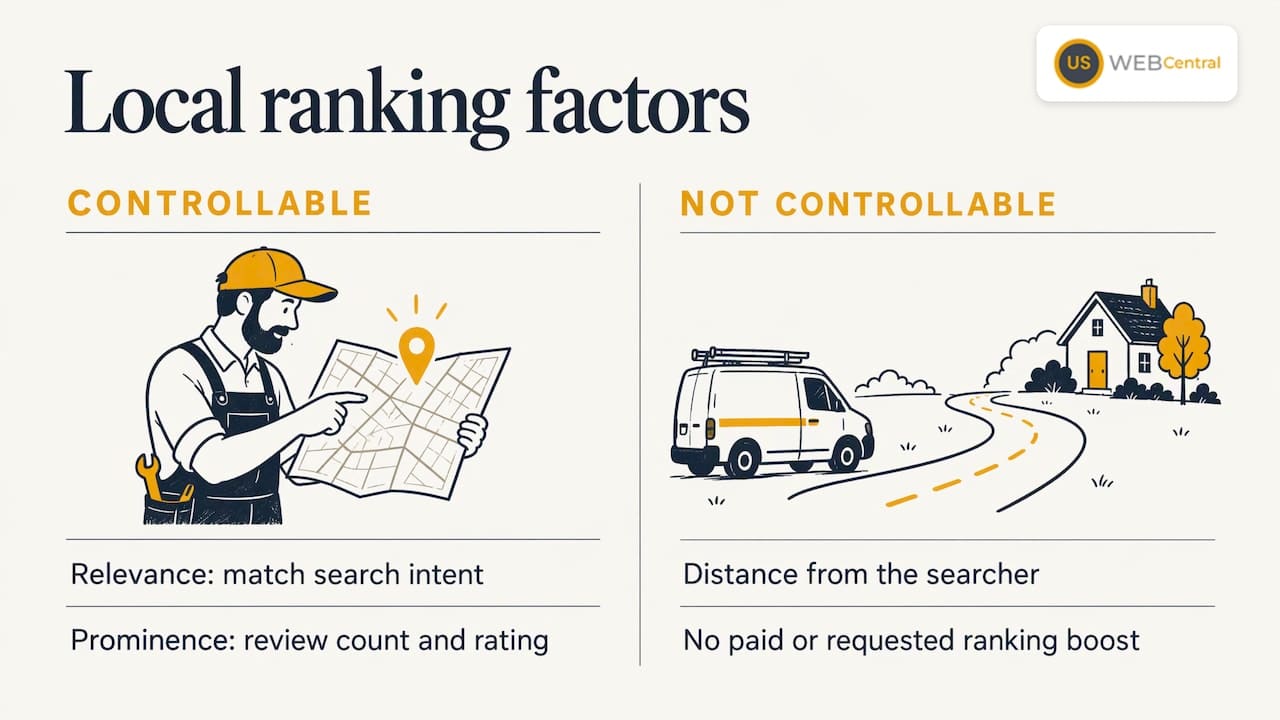
Google says local results are based on relevance, distance and prominence. As Search Engine Land explains, prominence is how well known a business is online and offline, and it includes your review count and average rating. You cannot change distance, but you can control the other two: how clearly your profile and pages match what people search for, and how much trust you show.
One point from Google itself is worth knowing early. Google states that there is no way to request or pay for a better local ranking. Anyone who promises a guaranteed spot on the map is selling something Google does not offer. What you can do is give Google accurate, complete information and give customers reasons to choose you.
Start with your Google Business Profile
For a plumber, the profile is the front door. It is what shows up in the map pack, and it often gets the call before your website is ever opened. If you do one thing this week, fix this.
Get the basics exactly right
Google’s local ranking guidance says to keep your information accurate, complete and engaging. That means:
- Primary category: choose the one that describes your core work. Add secondary categories only for services you really perform.
- Phone number: Google asks for a local number rather than a central call center line when possible, and warns against numbers or URLs that redirect to a different business or landing page.
- Hours: accurate hours, including how you handle emergency or after-hours calls.
- Services and description: list what you do in the words customers use, such as “water heater replacement” or “slab leak repair.”
- Photos: real trucks, real crews, real jobs.
Most plumbers also benefit from a closer look at how a profile is built and maintained. Our page on Google Business Profile optimization walks through what we set up for local service companies.
Set your service area honestly
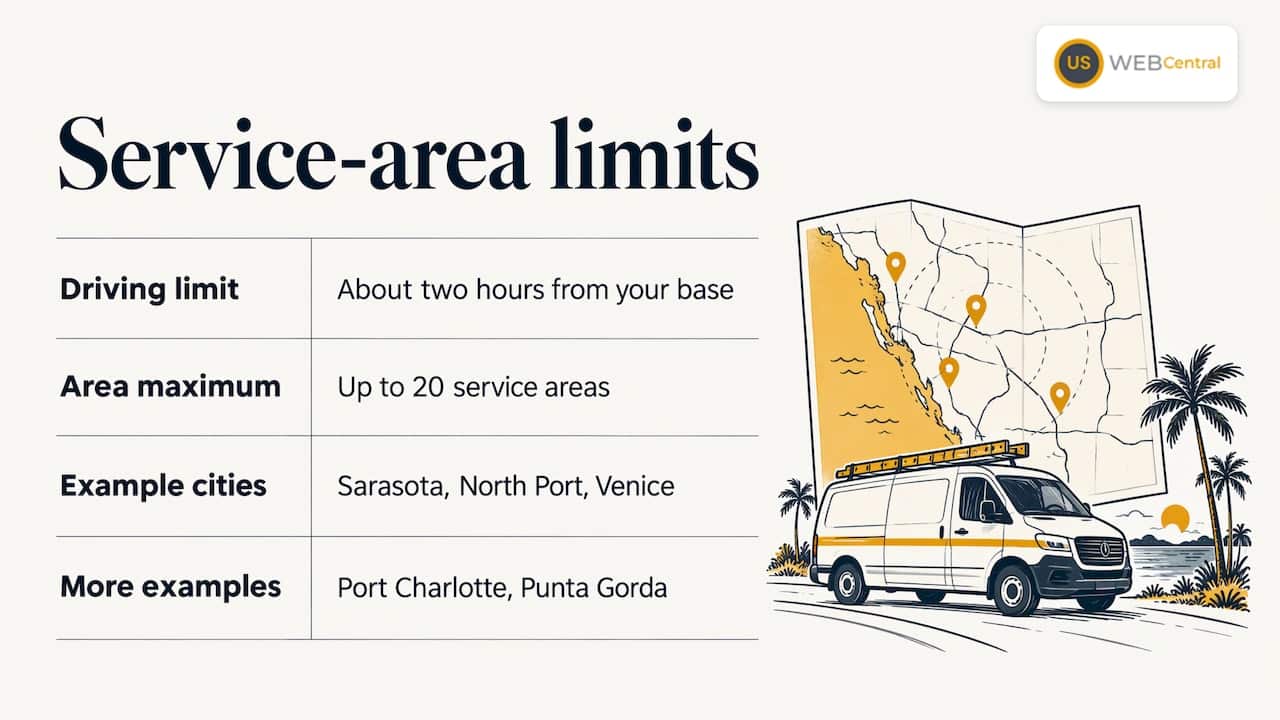
Many plumbers work out of a shop or a home and never see customers there. In that case, Google says a service-area business that does not serve customers at its address should remove the address from its profile. You can list up to 20 service areas by city, postal code or other area, and the overall area should not stretch much beyond about two hours of driving from your base.
For a Southwest Florida company, that might mean Sarasota, North Port, Venice, Port Charlotte and Punta Gorda. Choose the places you genuinely serve and want calls from. A list of 20 towns you never visit does not help you, and it makes your profile less believable.
Keep the profile and the website telling the same story
Your business name, address (if shown) and phone number should read the same on your profile, your site and every directory listing. This consistency is often called NAP: name, address, phone. Mismatches confuse Google and customers alike. If you have changed phone numbers or moved over the years, old listings are usually where the conflicts hide. Our citations and NAP consistency page explains how we clean these up.
Build service pages that match what people search
The plumbing keywords people use fall into clear groups: emergency work, repairs, installations and maintenance. A single “Services” page with a bulleted list cannot compete for all of them.
Search Engine Land recommends creating separate pages for each plumbing service and location, and matching each keyword theme to a page purpose: service pages for specific solutions, location pages for geographic searches, an About page for trust and credentials, and resource pages for informational questions.
Which services get a page
Ahrefs suggests building a page for each main service and starting with the ones people search for most. Similar services can share a page when Google returns nearly identical results for them. A practical starting list for a residential plumber:
- Drain cleaning and clogged drains
- Water heater repair and replacement
- Leak detection and repair
- Repiping
- Toilet, faucet and fixture repair
- Emergency plumbing
- Sewer line repair
If you handle commercial work, give it its own page. The customer, the questions and the buying process are different.
What each service page should contain
Ahrefs says an effective service page covers four things: clarity about the customer’s problem and your service, the catchment (where you work), confidence through reviews or credentials, and contact details that make reaching you easy. In practice:
- A headline that names the service and the area in plain words.
- A short explanation of the problem, how you diagnose it and what the job involves.
- Honest guidance on what affects the cost, without pretending every job is the same.
- Reviews from customers who had that exact service.
- Your license and insurance details, where you can show them.
- A tap-to-call phone number and a short form.
City pages without the copy-paste trap
It is tempting to clone one page across 15 towns and swap the city name. BrightLocal warns against repetitive city-name copy. It recommends using the location naturally in headings, body text and calls to action, and giving service-area pages genuinely useful local information instead of keyword-stuffed templates. It also suggests titles that combine the primary service, the region and a differentiating benefit.
So a Port Charlotte page might mention the local water conditions you deal with, the neighborhoods you serve most, typical housing types and a recent job there (with the customer’s permission). If you cannot say anything specific about a town, you probably do not need a page for it yet. Cover it in the service-area list on your main pages.
What your plumbing website needs to convert visitors
Ranking only matters if the visit becomes a call. Plumbing customers are often stressed and on a phone, so the site has to work in seconds.
Speed and mobile experience
Google recommends good Core Web Vitals: Largest Contentful Paint, Interaction to Next Paint and Cumulative Layout Shift. These measure how fast the main content loads, how quickly the page responds and how much it jumps around. Google also says that chasing a perfect score purely for SEO may not be the best use of your time, and that site owners should focus on overall page experience. The goal is a site that feels quick and stable, not a trophy number.
Mobile matters even more. Google uses the mobile version of your content for indexing and ranking, and recommends that it be equivalent to your desktop content. If your phone version hides service details or reviews that your desktop version shows, Google may not see them.
A free speed and error check is a sensible first step. As Search Engine Land notes, an SEO audit can find page errors such as broken links, and a speed analysis checks how fast the site loads. Our website audit covers both.
Structured data
Add LocalBusiness structured data so Google can read your business details, such as hours and departments, in a machine-friendly format. Most WordPress sites can add this through a plugin or built into the theme. Make sure the details match your profile.
The trust and contact checklist
- Your phone number in the header, tappable on mobile.
- Your service area stated in plain text.
- Real photos of your team and trucks, not stock images of smiling people in clean uniforms.
- Review excerpts placed beside the call to action.
- License number and insurance mention, where you hold them.
- A short form that asks only for name, phone and the problem.
Our approach to this is described on our page for web design and SEO for plumbing companies, and the same principles carry over to nearby trades such as HVAC companies and electrical contractors.
Reviews: the part customers read before they call
Since prominence includes review count and average rating, reviews help twice: they support your ranking and they decide close calls between two similar plumbers. A steady habit beats a burst.
- Ask at the end of the job, while the customer is relieved the water is back on.
- Send a direct link to your review page by text.
- Reply to every review, good or bad, in a calm, specific way.
- Mention the service and town in your reply when it fits naturally, without stuffing keywords.
Do not buy reviews or offer a discount for a positive one. It breaks the platform’s rules and customers can often tell.
Content that answers real plumbing questions
Service pages capture people ready to hire. Helpful articles catch earlier questions: why a water heater is leaking, what to do when a toilet keeps running, how to find the main shutoff valve. They build trust and give you pages to link to from your service pages.
Keep topics tied to what you actually do and know. Write from jobs you have done in your area. Search Engine Land recommends helpful informational content that answers common questions, and the keyword research behind it should weigh intent, volume, difficulty and what competitors are doing. Then adjust each page’s focus to its purpose.
AI search tools are also pulling answers from clear, well-structured pages. Plain headings, direct answers near the top of the page and consistent business details across the web make your content easier to quote. That is the thinking behind our Lumina AI Local Visibility Websites.
How to measure plumber SEO
A rank report tells you little if the phone is not ringing. Phloz recommends tracking Google Business Profile actions, tracked calls, website conversions and location-dependent local rankings, and reporting business-value actions such as calls, directions, bookings and visits rather than impressions or a single rank. It also notes that for many local businesses, calls and profile actions are the primary conversions, because key interactions happen inside Google and may not show up in website analytics.
A simple monthly scorecard:
| Measure | Where to find it | What it tells you |
|---|---|---|
| Calls from your profile | Google Business Profile performance | How many people tapped to call from Maps and search |
| Direction requests | Google Business Profile performance | Whether people are heading to your shop or office |
| Tracked calls from the website | Call tracking number or tool | Which pages produce real conversations |
| Form submissions | Your website or CRM | Leads outside business hours |
| Local rank in your service towns | A local rank checker, set by location | Whether you appear where you want work |
| Booked jobs | Your scheduling software | The number that matters most |
Match calls to booked jobs. Ask every new caller how they found you and write the answer down. It is low-tech and it catches what dashboards miss.
Can you do plumber SEO yourself?
Partly, yes. Ahrefs says plumbers can handle the basics themselves, especially creating service pages and optimizing for local search, while technical problems and link building may need a specialist. Its recommended starting point is to list your services, research demand, build the priority service pages, and make each one clear, locally relevant, credible and easy to contact.
The realistic split for a busy owner:
Do it yourself: claim and complete your Google Business Profile, ask for reviews, gather photos, write honest descriptions of your main services.
Hand it off: site speed fixes, structured data, listing cleanup, monthly content, link building and reporting. These take consistent hours that a plumber on a service call rarely has.
Our perspective
We build WordPress sites for contractors, clinics and service companies across Southwest Florida, and the pattern with plumbers is consistent. The business with the better-matched website and Google Business Profile tends to get the call, even when a competitor has the flashier logo.
That is why we treat the site and the profile as one system. The service pages say what the profile says. The phone number is the same everywhere. The pages load fast on a phone in a driveway. Then monthly content and citations keep the whole picture fresh instead of letting it go stale.
We also think SEO should be judged by the phone, not by a traffic chart. One HVAC company we worked with reported nearly tripling its website visits after optimization, and the point was never the visits themselves but the calls that came with them. That is the standard we hold our plumbing work to.
Scott Carvin
What it costs to have it done for you
If you would rather spend your time on jobs than on page edits, our Lumina package combines a custom WordPress website with a 12-month local SEO plan covering Google, Maps and AI search visibility. Published pricing: a setup fee of $1,500 and monthly maintenance and SEO at $500 per month. Hosting built for SEO is $250 per year. The Lumina Growth Engine setup is $500 one-off, and ad setup for Google, Meta or Sequence runs $100 per hour. Details are on the pricing and availability page.
Want to see where your company stands first? Start with a free website mockup or ask for an audit, and we will show you what is holding your site and profile back. You can also see our local approach on the local SEO services page.
A 30-day plan to get started
- Week 1: Audit your Google Business Profile. Correct the category, phone, hours and service areas. Add current photos.
- Week 2: List your services in order of how much money each earns, and check the search demand. Pick the top three for dedicated pages.
- Week 3: Build or rewrite those pages with the four elements above. Test them on your own phone.
- Week 4: Set up call tracking and a review request routine. Record a baseline for calls and profile actions, so you have a before and after.
Then repeat monthly: one new page or article, a handful of new reviews, and a quick check of your numbers.
FAQ
How long does plumber SEO take to work?
Profile fixes and review gains can show up in weeks, while new service pages usually take longer to build visibility. Timing depends on your competition and your starting point. Google does not publish a schedule, so judge progress by calls and profile actions month over month.
Do I need a separate page for every city I serve?
Not automatically. Build a page for a city when you can add useful local detail, like neighborhoods served and relevant jobs. Otherwise list the towns on your main service pages and in your profile’s service areas, which Google allows up to 20 of.
Is Google Business Profile more important than my website?
They work together. The profile tends to drive the map results, and the website supports it with detail, proof and a way to contact you. Neglecting either one weakens the other, so keep their information identical.
Can I pay Google to rank higher on the map?
No. Google says there is no way to request or pay for a better local ranking. Paid ads are a separate channel that appears alongside organic results, and many plumbers run them as a supplement to SEO, not a replacement.
What should I track to know if SEO is paying off?
Track calls, direction requests, form leads and booked jobs. Impressions and a single keyword rank can look good while the phone stays quiet. Ask every new customer how they found you to confirm what the numbers show.
Sources
- SEO for plumbers: How to rank higher & get more customers, Search Engine Land
- SEO for Plumbers: The Complete Guide, Ahrefs
- How to improve your local ranking on Google, Google Business Profile Help
- Tips to improve your local ranking on Google, Google Business Profile Help
- Manage your service areas, Google Business Profile Help
- Guidelines for representing your business on Google
- Local Business structured data, Google Search Central
- Understanding Core Web Vitals and Google search results
- Understanding Google Page Experience
- Mobile-first indexing best practices, Google Search Central
- How to Do Service Area Page SEO for Local Search Visibility, BrightLocal
- Local SEO measurement for agencies, Phloz