

SEO for contractors is the work of making your company show up when a homeowner nearby searches for the job you do. In practice that means three things working together: a Google Business Profile that wins the map listings, a fast website with a page for every service and town you cover, and consistent business details across the web. In Southwest Florida, where Sarasota, Port Charlotte, North Port and Fort Myers contractors compete for the same searches, one fixed package that handles all three is the most direct route. Our Lumina package does that for a $1,500 setup fee and $500 per month.
Key Takeaways
- Local results on Google are decided mainly by relevance, distance and prominence, so your profile, your website and your reviews all count.
- A contractor can appear twice on the first page: in the map listings and in the regular results. Each needs its own work.
- Google’s own guidance says SEO usually takes four months to a year to show benefit, so judge it on a 12-month view, not a 30-day one.
- The most common reason a good contractor does not rank is mismatched details: the website says one thing, the profile and directories say another.
- Lumina combines the website, Google Business Profile, citations and monthly content in one plan: $1,500 setup, then $500 per month.
Table of Contents
- What contractor SEO actually is
- How Google decides which contractor to show
- Step 1: Build a Google Business Profile that matches your work
- Step 2: Make your name, address and phone number consistent everywhere
- Step 3: Build a website that answers what a homeowner is asking
- Step 4: Publish content that earns the call
- Step 5: Earn links and reviews
- Step 6: Measure what matters, over the right timeline
- What contractor SEO costs
- Where contractor SEO goes wrong
- Why a single package works better for a local contractor
- Our perspective: matching beats volume
- See where your site stands
- FAQ
- Sources
What contractor SEO actually is
Search engine optimization (SEO) is the practice of improving your site and online presence so Google shows it to people searching for what you sell. For a contractor, that search is almost always local: “roof repair Port Charlotte,” “AC repair near me,” “electrician in Sarasota.”
A Search Engine Land guide to contractor SEO describes the job as optimizing local profiles, targeting the right keywords, improving the website and its content, and earning links. It also reports that 72% of consumers find information about local businesses by typing keywords into a search engine. Your next customer is probably typing right now, and the question is whether your name is on the screen.
The same idea applies whether you are a roofer, plumber, electrician, HVAC company, remodeler or pest control operator. The trade changes the keywords. The mechanics stay the same.
How Google decides which contractor to show
Google states how local results are chosen. According to Google’s Business Profile help page on local ranking, results are mainly based on three factors:
- Relevance: how well your profile matches what the person searched for.
- Distance: how far your business is from the searcher, or from the location they typed.
- Prominence: how well known you are, which Google says draws on things like links from other websites and the number of reviews and ratings you have.
The same page says there is no way to request or pay for a better local ranking. That shapes everything below. You cannot buy the top spot. You can only make your business the clearest match, in the right place, with the strongest proof.
You cannot change distance, because your shop is where it is. Relevance and prominence are the two you control, and they are where contractors win or lose.
Two places to appear on one page
When someone searches for a local service, Google usually shows a block of three or so map listings above or among the regular website results. That block is called the map pack, and it is fed by your Google Business Profile. Below it sit the regular organic results, which are fed by your website.
A contractor with a strong profile and a strong website can take a spot in both. A contractor with only one is leaving half of the first page to someone else.
Step 1: Build a Google Business Profile that matches your work
Your Google Business Profile is the free listing that appears on Google Search and Maps. For most home service companies it produces more calls than the website does, because the call button sits right on the listing.
What it takes:
- Choose the right primary category. “Roofing contractor” and “general contractor” are different, and the category tells Google which searches you are relevant for.
- Set your service area properly. Google’s guidelines for representing your business say service-area businesses, meaning those that visit customers at their locations, should have one profile for the central office with a designated service area. The same guidelines say the area should not extend farther than about two hours of driving from where you are based, though larger areas can suit some businesses.
- List every service, with a plain description of each. If you do tile and tub resurfacing, say so, instead of leaving it to a vague “remodeling.”
- Add real photos of finished jobs, and keep collecting reviews. Reviews feed the prominence factor above.
Where it goes wrong: a wrong category, an address that does not match your website, a service area drawn too wide, and a profile that is claimed once and never touched again. Profiles that sit untouched slide down the map listings while a competitor posts photos and answers reviews.
Our Google Business Profile work covers setup and ongoing management, and we match your profile to what your website says so Google sees one consistent business. Our guide to Google Business Profile optimization explains what we set up, and the post on how a neglected profile costs you leads shows what is at stake.
Step 2: Make your name, address and phone number consistent everywhere
NAP stands for name, address and phone number. Citations are the places those details appear outside your own site: Yelp, Apple Maps, Bing Places, the Better Business Bureau, industry directories and dozens of smaller listings.
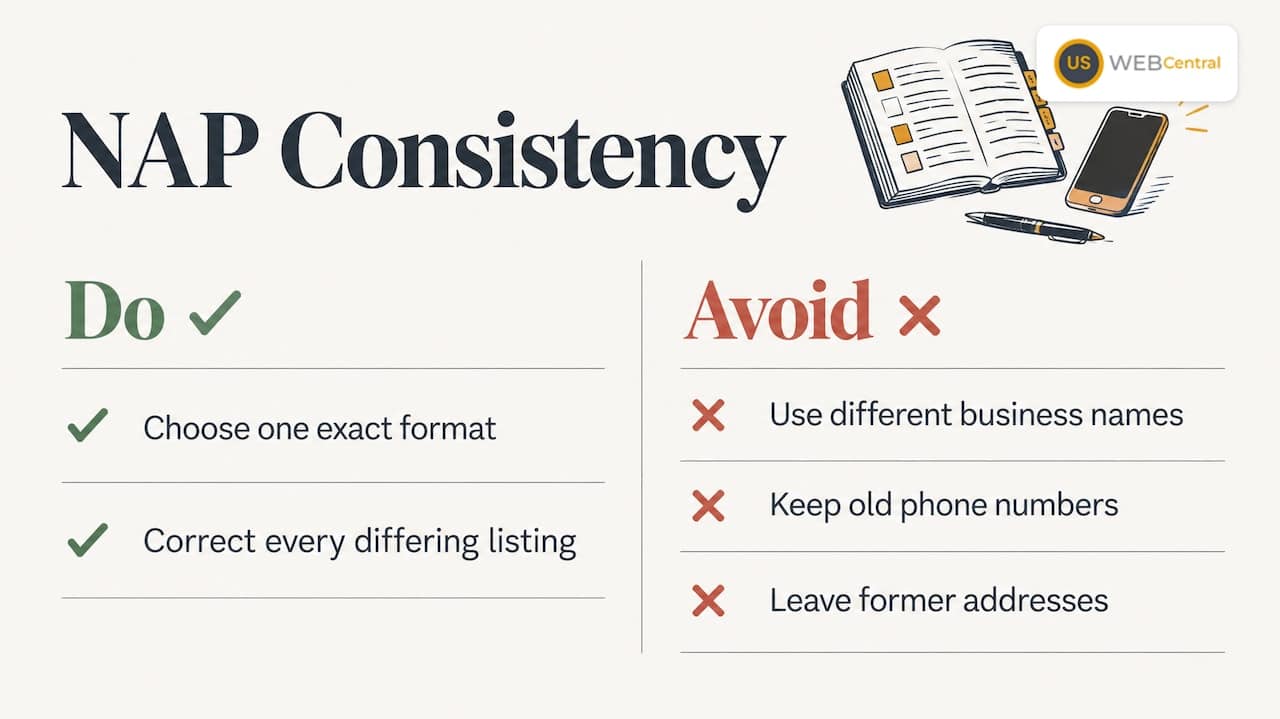
When “Smith Roofing LLC” is “Smith Roofing” on one directory, has an old phone number on another and carries a former address on a third, Google has to guess which version is right. Guessing weakens the confidence that makes a business prominent.
The fix is plain but tedious: pick one exact format, then find and correct every listing that differs. Contractors who have moved, changed phone numbers or rebranded usually have the most clean-up to do, and it is easy to miss a listing that only turns up years later.
Citations and NAP consistency are part of what we do for clients, and the same format goes on the website and the Google profile. You can read more on citations and NAP consistency and on fixing mismatched business listings.
Step 3: Build a website that answers what a homeowner is asking
A contractor website has two jobs: prove you are the right company, and make it effortless to call or request a quote. Google’s job is similar, which is why the same pages work for both.
One page per service, one page per area
A single “Services” page listing everything you do rarely ranks for anything. Give each core service its own page, and give each major town its own page where you genuinely work. A Sarasota electrician needs a panel upgrade page, an EV charger page and a whole-home rewiring page, each written about that job and mentioning the area.
What goes on each page:
- A title and description that include the service and the town, written for a person first.
- Plain explanations of the job, the typical process and what affects the price.
- Photos from real local jobs and a short customer quote where you have one.
- A phone number and a form that show without scrolling, on a phone as well as a desktop.
Where it goes wrong: thin pages that repeat the same paragraph with a different town name swapped in. Those read as filler to homeowners and to Google. Each page has to say something specific.
We have written trade-specific guides that show what this looks like: plumber SEO, electrician SEO, and our pages on web design and SEO for roofing contractors and for electrical contractors.
Speed, mobile and structure
Most people who search for a plumber with water on the floor are holding a phone. The Search Engine Land guide lists site speed and responsiveness, site structure and security among the factors that matter. A slow site loses the caller before the page finishes loading.
Speed depends on both the build and the hosting. We build fast, responsive WordPress sites, offer PageSpeed Insights optimization and run SEO hosting at $250 per year. Our page on SEO-friendly web design explains how we structure a site for search.
Step 4: Publish content that earns the call
Content is how your website answers questions before a competitor does. For a contractor that means pages and posts built on what customers actually ask:
- How much does a roof replacement cost in Charlotte County?
- Do I need a permit to replace a water heater?
- How do I know if my AC needs repair or replacement?
- What does a whole-house surge protector do?
Each answer should come from your real experience in the area: local building rules, local weather, local housing stock. Florida homes, for example, have roofing and cooling needs that a national article cannot address.
AI-driven search is raising the stakes. Tools like ChatGPT and Google’s AI answers pull from pages that state clear facts about who you are, what you do and where. That is why our monthly content is written to be AI-ready, with direct answers and consistent business details that match your profile. See how we think about it in SEO marketing to machines.
Step 5: Earn links and reviews
Prominence, in Google’s words, draws on how many websites link to you and how many reviews you have. For a contractor, the realistic sources are:
- Reviews from every finished job, asked for while the customer is still happy.
- Local chambers of commerce, trade associations and supplier pages that list members.
- Local sponsorships and community projects that get written up by a local site.
Quality beats quantity. A handful of local, relevant links is worth more than hundreds of random directory submissions. Reviews are the easiest win and the most neglected: reply to every one, positive or negative, and keep a steady flow rather than a burst.
Step 6: Measure what matters, over the right timeline
Google’s Search Central guidance on hiring an SEO is quoted in a Search Engine Land timeline guide: in most cases SEO needs four months to a year to implement improvements and see the benefit. That timeline is why a 12-month plan is a sensible unit to judge.
Track the numbers that connect to revenue:
| What to track | Why it matters | Where to see it |
|---|---|---|
| Calls from your Google Business Profile | Most direct measure of map pack success | Your Business Profile performance data |
| Form submissions and calls from the website | Shows whether visitors become leads | Website analytics and call tracking |
| Website visits from search | Shows whether pages are being found | Google Analytics, Search Console |
| Review count and rating | Feeds prominence and trust | Your Business Profile |
| Booked jobs from search leads | The number that pays for everything | Your own job records |
Rankings alone mislead. A first-page position for a keyword nobody buys on is worth nothing, while ten extra calls a month from “AC repair Venice” are worth a lot. One Sarasota HVAC company we worked with nearly tripled its website visits after optimization, and the AC Heroes case study shows the before and after.
What contractor SEO costs
Prices vary widely by provider and scope, and a monthly retainer that does not include a website, profile work and content often turns out to be only part of the bill. The more useful comparison is what the whole package includes.
Our published Lumina pricing is:
| Item | Price |
|---|---|
| Setup fee | $1,500 one-off |
| Monthly Maintenance & SEO | $500 per month |
| SEO hosting | $250 per year |
| Lumina Growth Engine setup (optional) | $500 one-off |
| Sequence, Meta or Google Ads setup (optional) | $100 per hour |
That is a custom WordPress website, Google Business Profile setup, citation and NAP work, technical and on-page local SEO, and monthly AI-ready content in one plan, with the website and the SEO built to match. Current availability and terms are on our Lumina pricing page.
Where contractor SEO goes wrong
These mistakes hold back otherwise good companies:
- A website built for looks, not search. A handsome site with one services page and no local content has nothing to rank.
- Inconsistent business details. The profile, website and directories each tell a slightly different story.
- Treating SEO as a one-time project. Competitors keep adding reviews, photos and pages. Standing still means sliding back.
- Ignoring the phone experience. If the call button is hard to find on a phone, rankings will not save the lead.
- Chasing traffic instead of leads. Visits are only useful when they turn into calls.
The common thread is that website, profile and listings are treated as three separate jobs, often handled by three separate vendors. They work best as one system.
Why a single package works better for a local contractor
Most contractors are good at the trade and short on time. Doing local SEO well means coordinating a website build, profile management, listing clean-up, content and technical monitoring, and doing it every month for a year or more.
Lumina is built so that work arrives together. The website is designed for Google and AI citation, the profile matches the website, the citations match both, and the monthly content builds on all three. You work directly with the team doing the implementation, and the turnaround is fast. We have built more than 1,000 sites since 2005, and our focus is service businesses competing in local search: contractors, clinics and home service companies across Sarasota County, Port Charlotte, Punta Gorda, Fort Myers, Cape Coral and nearby.
Our perspective: matching beats volume
We have built sites since 2005, and the pattern is consistent. Contractors rarely lose local search because they lack effort. They lose it because their website, their Google profile and their directory listings do not agree with each other.
That is why we do not sell SEO as a list of separate tasks. Lumina starts with a custom website structured for Google and for AI answers, then sets up the Google Business Profile to match it, then aligns the citations and keeps publishing content every month. The goal is real results, more calls and more booked jobs, not a traffic report that looks good and changes nothing.
Local search is also changing. People increasingly ask AI tools who to hire, and those tools read the same signals Google does: clear services, consistent details, real reviews. A contractor who gets those signals right now is ready for both.
Scott Carvin
See where your site stands
If you are not sure whether your website and profile are working together, start with a review of the site itself. Our website audit looks at the technical and local SEO basics so you know what is holding you back before you commit to anything.
When you are ready to build, Lumina is our all-in-one package: a custom WordPress website, a 12-month local SEO plan, Google Business Profile setup and monthly content, for a $1,500 setup fee and $500 per month. See the details on our Lumina AI Local Visibility Websites page.
If you also want paid leads alongside organic ones, the optional Lumina Growth Engine adds CRM and ad integration to the same system.
FAQ
Is it worth paying someone for SEO as a contractor?
For most contractors, yes, when the provider handles the website, the Google Business Profile and the listings together and the contract runs long enough to see results. Google’s guidance puts the typical timeline at four months to a year. The test of value is calls and booked jobs, not rankings.
How long before contractor SEO brings in leads?
Plan on several months. Google’s Search Central guidance, as reported by Search Engine Land, says SEO usually needs four months to a year to show benefit. Profile and listing fixes often come first, while new service and area pages build up over the following months.
What is the difference between local SEO and regular SEO for contractors?
Regular SEO aims to rank a website anywhere. Local SEO aims to put you in front of people in your service area, in the map listings and in the local organic results. It adds the Google Business Profile, reviews, consistent business details and pages for each town you serve.
Do I need a separate page for every city I serve?
You need a page for each major area where you actually work, written with specific details about that area and the jobs you do there. Copying one page and swapping the town name does not help. Start with the towns that bring you the most work, such as Sarasota, Port Charlotte or Fort Myers, and add from there.
What is the 80/20 rule for contractor SEO?
It is the idea that a small share of your effort produces most of your results. For a local contractor, that share is usually the Google Business Profile, the service pages for your most profitable jobs, and reviews. Get those right before spending time on anything else.
Sources
- How to do SEO for contractors (5 steps + examples), Search Engine Land
- Tips to improve your local ranking on Google, Google Business Profile Help
- Guidelines for representing your business on Google, Google Business Profile Help
- How long does SEO take to work?, Search Engine Land