

A good roofing website does three things fast: it shows a homeowner you do the job they need, it proves you serve their town, and it makes calling or requesting an estimate a one-tap action. Everything else, from the color scheme to the photo gallery, supports those three jobs. This guide covers the pages, mobile details, local SEO and trust signals that matter, and the same principles apply if you run a landscaping company.
We build WordPress sites for local service businesses in Southwest Florida, so the examples below lean toward Sarasota, Port Charlotte, Fort Myers and the surrounding area. The advice holds anywhere a homeowner searches on a phone with a leak in the ceiling or a storm on the way.
Key Takeaways
- Give every major roofing service (repair, replacement, tile, metal, storm damage) its own page, and give your main service towns real local content rather than copied text.
- Design for the phone first: a tap-to-call button and a short estimate form should be visible without scrolling.
- Your site and your Google Business Profile must say the same thing: same name, address, phone number, services and service area.
- Real project photos, reviews and licensing details do more for trust than stock images and slogans.
- A custom Lumina website with a 12-month local SEO plan from us costs a $1,500 setup fee and $500 per month.
Table of Contents
- What a roofing website is really for
- The pages every roofer’s website needs
- Mobile design: where roofing leads are won or lost
- Local SEO: making the site findable in your towns
- Trust signals that turn visitors into estimate requests
- Measure what the site produces
- A note for landscapers
- Our perspective
- What this looks like with us
- How to plan or rebuild your roofing website
- FAQ
- Sources
What a roofing website is really for
A roofing site is not a brochure. It is the place where a homeowner who already has a problem decides whether to call you or the next name in the results. Roofing is a high-ticket, high-stress purchase. Nobody browses for fun, and most visitors are comparing two or three contractors within minutes.
That changes how you design. A designer who optimizes for a handsome homepage will give you a nice-looking site. A designer who optimizes for the decision will give you a site that answers the homeowner’s questions in the order they ask them:
- Do you do the work I need (repair, full replacement, tile, shingle, metal, storm damage)?
- Do you serve my area?
- Can I trust you (license, insurance, reviews, real jobs)?
- How do I reach you right now?
Housecall Pro makes the same point for landscapers: a good home-service website helps a homeowner quickly learn what you offer, whether you serve their area and how to hire you. Swap “lawn care” for “roof replacement” and the logic is identical.
The pages every roofer’s website needs
Most contractor sites fail by cramming everything onto one page. Search engines and homeowners both do better with a clear structure.
Homepage
The homepage should state, in the first screen, what you do and where. “Roof repair and replacement in Sarasota and Manatee Counties” says more than a slogan. Put your phone number, a primary button for a free estimate or inspection, and one line of proof (years in business, license, review rating) in that first view.
One page per service
Repair, replacement, inspection, leak detection, tile roofs, metal roofs, flat and commercial roofing, storm damage and insurance claim help each deserve a page that explains the process, materials, typical timeline and what the homeowner should expect. A thin paragraph under a “Services” tab does not do this. Dedicated service pages also help you rank: Whitespark’s 2026 Local Search Ranking Factors survey, which scored 187 factors with 47 local search experts, includes a dedicated page for each service among the factors that influence local organic rankings.
Write each page for the person with that exact problem. A storm damage page should tell someone what to photograph, what to do about a tarp and how an inspection works. A replacement page should explain how you handle permits, tear-off, underlayment and cleanup.
Service area and city pages
If you serve Sarasota, North Port, Port Charlotte, Punta Gorda, Englewood and Cape Coral, each town can have its own page, but only if it contains something specific to that town: neighborhoods you work in, the roof types common there, local permitting notes, projects you completed and reviews from customers nearby. Whitespark’s survey also lists geographic keyword relevance of page content among its ranking factors. Copying the same text and swapping the city name does not give a homeowner a reason to trust you, and it gives search engines little reason to rank you.
Gallery and project pages
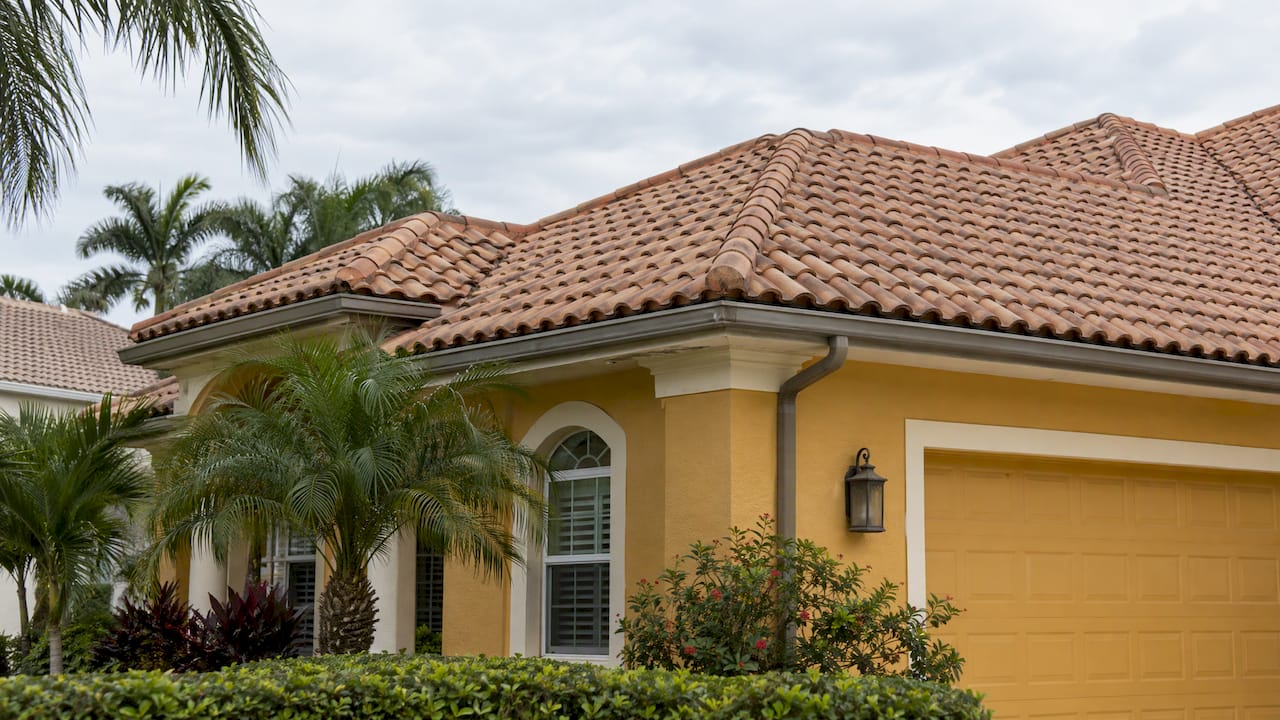
Real photos of real roofs beat stock images every time. Show before and after shots, label the roof type and town, and add a sentence on what the job involved. These pages also give you material for local content and for your Google Business Profile.
Reviews and about pages
Homeowners want to see who is going to climb onto their roof. Show your team, your license and insurance information, manufacturer certifications you actually hold and a selection of reviews with names and towns. Link out to your review profiles so people can verify them.
Contact and estimate page
Keep it simple: your phone number, a short form, your service area and your hours. Nothing else should compete for attention.
Mobile design: where roofing leads are won or lost
Most roofing searches happen on a phone, often in a hurry. ServiceTitan’s roofing website guide lists mobile friendliness, lead-capture forms, local search optimization, reviews, financing, chat and online scheduling among the core features of a roofing site, and treats a poor mobile experience as a sales problem, not just a technical one.
In practice, a mobile-ready roofing site has these elements:
- A tap-to-call button on the first screen. The phone number must be a real tap-to-call link, not plain text. On a phone it should be sticky, so it stays visible as the visitor scrolls.
- A short form. Name, phone, address or ZIP, type of service and an optional message are enough. Every extra field costs you requests.
- Action-specific buttons. “Get My Free Roof Estimate” tells the visitor what happens next. “Submit” does not.
- Large tap targets and readable text. Thumbs are not mouse pointers. Buttons need space around them.
- Fast loading. Heavy slider images and bloated page builders are the usual culprits. Compress photos, use modern formats and host on a fast server.
- No pop-ups that cover the call button. An annoying overlay on a phone sends an anxious homeowner back to the results.
This is why speed and hosting are part of our package rather than an afterthought. A site that looks great but takes several seconds to show its first screen loses the emergency caller before they read a word.
Local SEO: making the site findable in your towns
A beautiful roofing site that nobody finds earns nothing. Local search for a roofer works on two tracks at the same time: the regular results and the map results. Appearing in both gives you two chances to be seen on the first page.
Google Business Profile
Your Google Business Profile often decides the call before anyone visits your site. Choose the right primary category, list every service, set your service area, add real photos, keep your hours accurate and respond to reviews. If you want a walkthrough, see our guide on how to optimize your Google Business Profile, or read about our Google Business Profile optimization service.
The key link between profile and website is consistency. The services, business name, phone number and area on your profile should match what is on your site. Mismatches confuse both customers and search engines, and matching them is a core part of how we build.
Citations and NAP consistency
NAP means name, address and phone number. Your business appears on directories, maps and data aggregators, and when those listings disagree with each other (an old phone number, a suite number that changed, “LLC” in one place and not another), trust in your listing suffers. Cleaning them up is unglamorous work that pays off. We cover the approach on our page about local SEO citations and NAP consistency.
Schema markup and technical basics
Structured data tells search engines what your business is, where it operates and what it offers. A roofing contractor site should carry LocalBusiness or roofing-specific markup, clean title tags that name the service and town, a sensible heading structure and a sitemap. These are invisible to visitors but they help Google and AI assistants understand and cite your business.
Reviews
Reviews influence both ranking and the decision to call. Make it easy for happy customers to leave one: send a direct link right after a finished job, while the new roof is still a good memory. Reply to every review, including the critical ones, calmly and specifically.
Getting found in AI answers
Homeowners increasingly ask assistants like ChatGPT who the best roofer is in their town. The assistants draw on the same signals: clear service pages, consistent business information, reviews and well-structured content. Our AI Visibility Audit looks at how your business appears across these sources today.
Trust signals that turn visitors into estimate requests
A roof can cost many thousands of dollars, so visitors look for reasons to trust you. Put these where they can be seen without hunting:
- License number and proof of insurance
- Manufacturer certifications you hold
- Warranty terms in plain language
- Reviews with real names and towns
- Project photos from jobs in the area
- A clear description of your process, from inspection to final cleanup
- Financing or payment information, if you offer it
- Price guidance, even as ranges or the factors that move a quote
Being open about cost is a trust builder most roofers skip. You do not need to publish a price list, but explaining that a quote depends on roof size, pitch, material, tear-off layers and decking condition shows you are straightforward.
Measure what the site produces
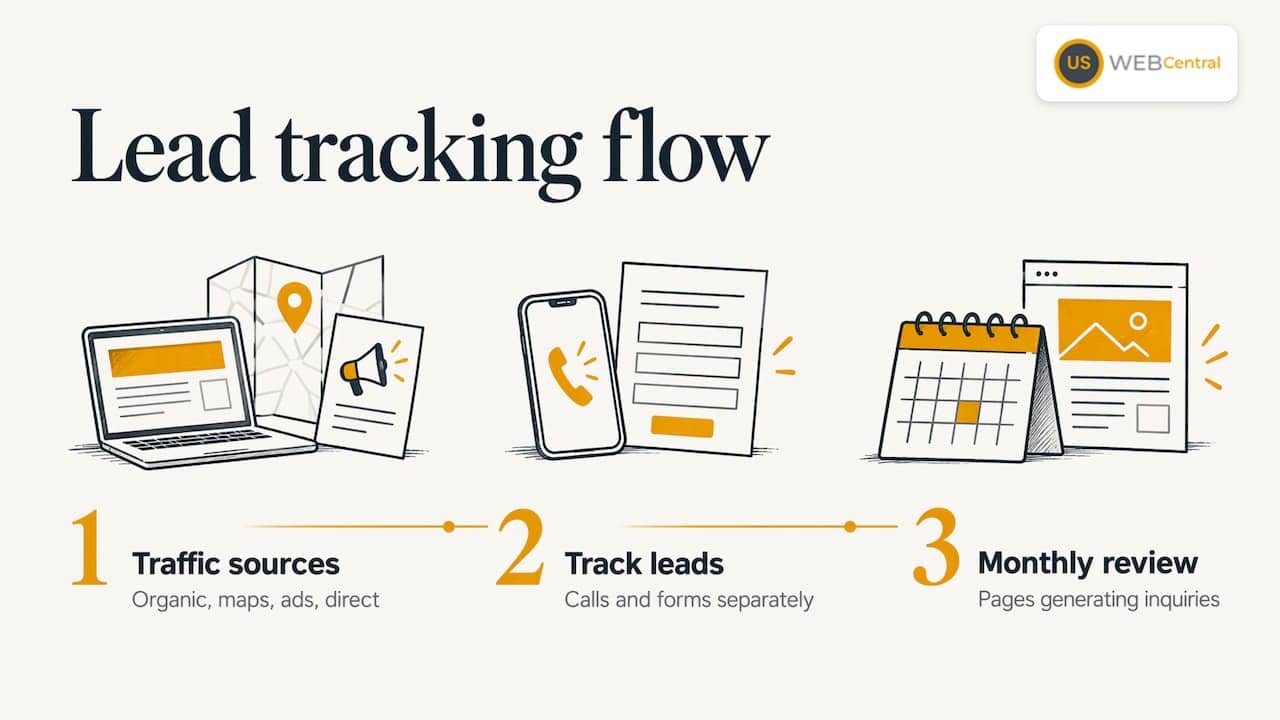
A website you cannot measure is a guess. Track form submissions and phone calls separately, and tag where they come from: organic search, map listing, ads or direct. Roofing leads are expensive when bought through ads, so knowing which calls came from free search is worth real money. At minimum, set up call tracking or call-click tracking, a thank-you page for form submissions and a monthly review of which pages bring the most inquiries.
A note for landscapers
If you run a landscaping or lawn care company, the same structure applies with different content. Give each service (design, installation, lawn maintenance, irrigation, tree trimming, hardscape) its own page. Show seasonal work and finished projects. Make the area you serve obvious. Keep the phone number and a quote button in thumb reach. Landscaping also has strong informational search demand, so helpful pages on lawn care questions can bring in homeowners before they are ready to hire, as long as each guide points toward your services in your service area.
Our perspective
Most roofing websites we audit look fine and still fail, because they were designed as a picture of the company instead of a path to a phone call. The homeowner does not care about your slideshow. They want to know you do their kind of roof, that you work in their town, and how to reach you in one tap.
That is why we build the website and the local SEO together. A site, a Google Business Profile and a set of citations that all say the same thing give Google and AI assistants a clear picture of who you are, and give the homeowner a reason to pick up the phone. We work directly with the implementation team, so the person who plans your pages is the person who builds them.
Pretty is not the goal. A site that earns calls is. We have built over 1,000 sites since 2005, and the pattern holds: structure, speed, local proof and consistency beat decoration.
Scott Carvin
What this looks like with us
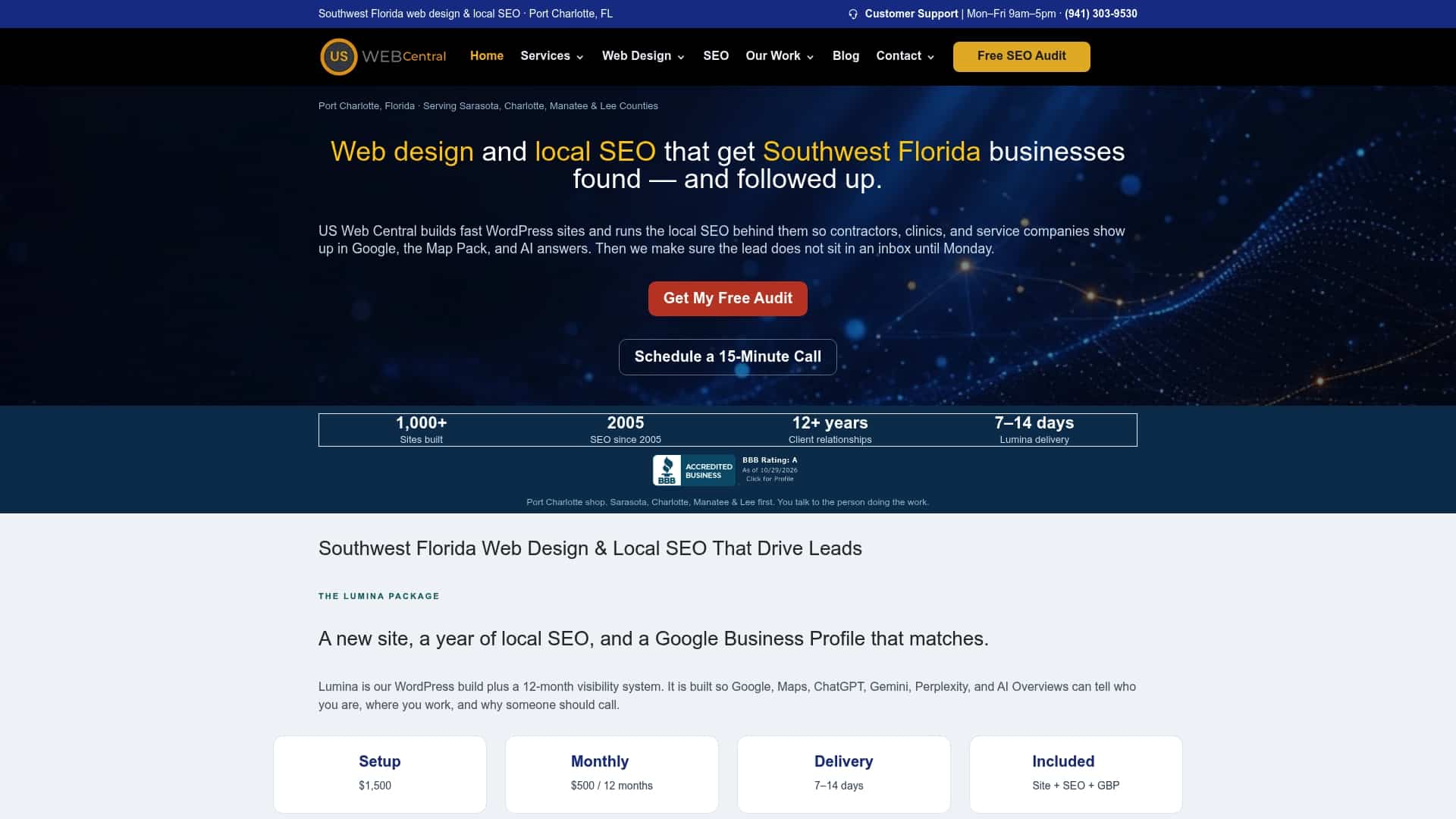
Our Lumina package is a custom WordPress website built for local service businesses, with a 12-month local SEO plan behind it. For a roofer, that means service pages and town pages structured for Google and AI citation, Google Business Profile setup matched to your site, citation and NAP cleanup, monthly AI-ready content and fast, SEO-focused hosting.
The published pricing is a one-time setup fee of $1,500 and $500 per month for maintenance and SEO. SEO hosting is $250 per year, and the optional Lumina Growth Engine setup is $500 one-off. Advertising setup for Sequence, Meta or Google Ads is $100 per hour. Current availability and details are on our Lumina pricing page.
Want to see how a roofing site we built is structured? Look at our Green Roofing before and after case study from Nokomis, or read about our web design and SEO for roofing contractors. When you are ready, get your free audit and we will show you where your current site and profile are losing calls.
How to plan or rebuild your roofing website
Whether you work with us or not, this order keeps a project on track:
- List your services and towns. Decide which jobs you want more of (replacements pay differently than repairs) and which towns you actually want to serve.
- Gather real proof. Collect project photos, reviews, license and insurance details and warranty terms before the design starts. Sites stall when content arrives late.
- Map the pages. One page per major service, one per priority town, plus home, about, gallery, reviews and contact.
- Design mobile first. Check every page on a real phone, with a real thumb.
- Match your profile. Update your Google Business Profile and directory listings so every detail agrees with the site.
- Set up tracking. Calls, forms and sources, from the day the site launches.
- Publish steadily. Fresh project posts and helpful local content keep the site current. Our local SEO services include ongoing content for this reason.
FAQ
How much does a roofing website cost?
Costs vary widely by provider and scope. With us, a Lumina website and local SEO plan has a $1,500 one-time setup fee and $500 per month, with SEO hosting at $250 per year. That covers the custom WordPress site, local SEO, Google Business Profile setup and monthly content.
How many pages should a roofing website have?
Enough to give each major service and each priority town its own useful page, plus the core pages: home, about, gallery, reviews and contact. A small roofer might launch with 10 to 15 pages and grow from there. Quality matters more than count, so every page needs content specific to its service or town.
Do I need a different site if I do landscaping as well as roofing?
Usually one site can serve related trades if each service has its own clear section and pages. If the two businesses have different names, customers and service areas, separate sites and separate Google Business Profiles are cleaner. We can help you decide based on how you operate.
What should be on the first screen of a roofer’s mobile site?
Your business name, what you do and where, a tap-to-call button, a free estimate button and one proof point such as your review rating or license. A homeowner should know within a few seconds that you do their job in their town and how to reach you.
How long before a new roofing website brings leads?
It depends on your market, your starting point and how competitive your towns are. Local search results build over months, which is why our plan runs for 12 months with ongoing content and profile management rather than a one-time launch.
Sources
- Housecall Pro: Lawn Care & Landscaping Website Design
- Whitespark: 2026 Local Search Ranking Factors
- ServiceTitan: Roofing Websites and Improvement Tips