

Online reputation management (ORM) is the ongoing work of monitoring, shaping and improving what people find and read about your business online: Google reviews, your Google Business Profile, search results, social media, directory listings and, more and more, AI answers. For a local service company or clinic, it comes down to one habit: know what customers see when they look you up, and make sure it is accurate, current and earns the call.
This guide explains how ORM works, what a practical routine looks like for a Southwest Florida contractor or clinic, what the rules are for medical practices, and what it costs.
Key Takeaways
- ORM is a routine, not a one-time cleanup: monitor, respond, build positive proof, and keep your listings consistent.
- For local businesses, most of the work happens on Google reviews, your Google Business Profile and your website, because that is where customers decide.
- Clinics must reply to reviews without confirming anyone is a patient. A generic, privacy-safe reply is the standard.
- Software for small businesses is priced per month, while done-for-you agency work costs far more. Match the service to the number of locations and review sources you actually have.
- Never buy or fake reviews. Federal rules now target the practice with civil penalties.
Table of Contents
- What online reputation management actually covers
- Why reputation decides who gets the call
- How reputation management works: the cycle
- A monitoring routine you can keep
- Responding to reviews, good and bad
- Getting more reviews the right way
- Your Google Business Profile and listings are the foundation
- Reputation management for clinics and medical practices
- What a strategy should include
- What reputation management costs
- Where Lumina fits
- A 30-day starting plan
- FAQ
- Sources
What online reputation management actually covers
ORM concentrates on how a business is perceived on the internet, including reviews, social media, search engine results pages and press coverage, plus monitoring and responding to customer feedback, ratings, posts and comments.
One useful way to sort the work is by who controls the channel. Semrush describes four media types: paid (ads and sponsored posts), earned (press coverage, forums and external reviews), shared (social media) and owned (your website and email newsletters). A local business controls owned media completely, influences shared media, and can only earn the rest. That is why the website and Google Business Profile come first.
ORM has also reached AI search. Guides now include AI-generated summaries from tools like ChatGPT and Google AI Overviews among the places a reputation is formed. When someone asks an AI assistant for a trusted roofer in Sarasota, the answer draws on the same signals: reviews, listings and website content. We cover that side in our guide to improving AI search visibility for a local business.
Why reputation decides who gets the call
The numbers from the research are consistent. ReviewTrackers reports that 63% of consumers check Google for reviews before visiting a business, and that 94% have avoided a business because of a negative review. Semrush cites a finding that almost 60% of U.S. consumers would avoid buying from a brand that comes across as untrustworthy.
Reviews also age quickly. The BBB, citing a BrightLocal survey, notes that more than 80 percent of people thought reviews over three months old were irrelevant. A great year in 2024 does not help you if nothing has been posted lately. Fresh, steady reviews matter more than one big burst.
For home service companies in Sarasota, Port Charlotte or Cape Coral, this plays out at the moment of need: a customer with a broken AC searches, sees three businesses in the map results, and compares star ratings and recent comments in seconds. We wrote about that moment in how Google reviews decide the call in Southwest Florida.
How reputation management works: the cycle
The process is a loop rather than a project. Brandwatch describes a four-stage cycle: monitor what people say, analyze sentiment and reach, take action by amplifying positive content or responding to negative mentions, and maintain your presence through consistent engagement.
For a local business, that translates into four plain tasks:
- Monitor. Know every place your business name appears.
- Respond. Reply to reviews and questions quickly and professionally.
- Build. Publish accurate, useful content and ask happy customers for reviews.
- Maintain. Keep your name, address and phone number consistent everywhere, and repeat the cycle.
Some providers also describe a “reputation stack” of monitoring, removal and suppression. Removal applies when content breaks a platform’s policy or is outdated. Suppression means strengthening positive pages so weaker results sit lower. For most local service businesses, the monitoring and building layers do almost all of the work.
A monitoring routine you can keep
Monitoring does not need an expensive tool to start. Xero’s small business guide recommends three habits: set up Google Alerts for free email notifications, check review sites such as Google Maps and Yelp weekly, and search your business name monthly to see what appears on the first page.
A simple schedule for an owner or office manager:
- Weekly (15 minutes): read new reviews on Google, Yelp and any industry platform, and reply to each.
- Monthly (30 minutes): search your business name in a private browser window, check the map listing, and confirm hours, phone number and services are right.
- Quarterly: audit your listings across directories, and look at what AI assistants say when asked about your trade in your city.
A fuller audit, as one platform vendor outlines, covers review platforms, social media, listing accuracy, search and AI-generated results, news and user-generated content. Our AI visibility audit looks at that same ground for Southwest Florida businesses.
Responding to reviews, good and bad
Replies are public. Future customers read them as closely as the review itself.
For positive reviews, thank the customer and acknowledge a specific detail, such as the technician’s name or the job type. Xero advises exactly this.
For negative reviews, the BBB recommends responding promptly, staying respectful without denials or excuses, and telling customers how to reach you offline. One local business guide suggests replying within 24 hours and keeping the response under four sentences, acknowledging the concern without admitting liability for unverified claims, and inviting the customer to resolve it privately.
A reply structure that works for contractors:
- Thank them for the feedback.
- Acknowledge the specific concern in one sentence.
- Offer a direct contact (a name, a phone number, an email).
- Stop. Do not argue the details in public.
Responding is worth the effort: ReviewTrackers reports that responding to negative reviews makes 45% of consumers more likely to still visit. Take a few minutes before you post. Anyone who has written a reply while angry knows why. Our negative review playbook for local businesses has templates.
For reviews that look fake, state the facts in a short reply and report the review to the platform at the same time, as the same local guide recommends. The BBB also notes that the Consumer Review Fairness Act protects honest reviews but does not protect reviews that are abusive, vulgar or threatening.
Getting more reviews the right way
Reputation is built mostly by volume of honest feedback from satisfied customers. Ask at the right moment: right after the job is done or the visit is complete. ReviewTrackers notes that up to 70% of online reviews come from business emails sent after a purchase and that mobile devices account for 56% of local search, which makes text messages an effective request channel.
Practical steps:
- Send a direct link to your Google review form, so it takes one tap.
- Ask every customer, not only the ones you expect to be happy.
- Make the ask part of your closing routine: invoice, thank-you, review link.
- Never pay for reviews or write them yourself.
That last point is now a federal enforcement matter. In August 2024 the FTC announced a final rule prohibiting the sale or purchase of fake reviews and allowing civil penalties against knowing violators. Reviews you earn are safer and more persuasive anyway.
Your Google Business Profile and listings are the foundation
For a local company, the Google Business Profile is often the first thing a customer sees. Reviews, photos, hours, services and answers to questions all live there. Keep it complete and current, and make sure it matches your website word for word on name, address, phone and services. Our guides on optimizing your Google Business Profile walk through each field.
The same consistency applies to directories. Wrong phone numbers or an old address on a dozen listing sites create confusion for customers and for search engines. Fixing them is part of citations and NAP consistency. Also claim your profiles on as many relevant platforms as you can, as the BBB advises.
Your website supports all of this. Clear service pages, real project photos, service-area details and trust signals give search engines and AI tools something accurate to quote. See how E-E-A-T affects SEO performance for the trust signals that matter.
Reputation management for clinics and medical practices
Clinics face a rule that contractors do not: patient privacy. Replying to a review the way a plumber would can create a legal problem.
The HHS Office for Civil Rights position, as summarized by a practice management company, is that publicly confirming or denying that someone is a patient, or referencing any detail of their visit, is a HIPAA violation, even when the patient disclosed their status in the review. The Texas Medical Liability Trust makes the same point: even acknowledging publicly that the reviewer is a patient breaches confidentiality.
What a privacy-safe reply looks like. The American Dental Association suggests responding in generalities, for example that the office strives to ensure a great patient experience and invites the person to call. It also advises dental practices to Google the practice name in incognito mode and check Google and Yelp reviews regularly.
Two more safe-use points for clinics:
- Possible legal action. If a review hints that the patient is considering legal action, the Texas Medical Liability Trust urges physicians to contact their liability insurance carrier and attorney before saying anything, since a response can come back in court.
- Collecting reviews. Compliant requests go to all patients after the appointment with a direct review link and neutral wording, with no incentives for positive reviews and no penalties for negative ones.
Have your compliance officer or healthcare attorney approve your reply templates once, then use them consistently.
What a strategy should include
A written plan keeps the routine from slipping. Forbes Advisor says a strategic ORM plan should cover the priority tasks and tactics, guidelines for responding to customers, a consistent tone of voice across channels, how to document efforts, and who is in charge of what.
For a small business, one page is enough:
| Element | What to write down |
|---|---|
| Owner | Who checks and replies to reviews each week |
| Response rules | Time limit, tone, what never goes in public |
| Review requests | When and how each customer is asked |
| Listings | Where you are listed and the exact name, address and phone |
| Escalation | Who handles threats, legal language or safety claims |
| Review date | Monthly check-in on ratings, volume and new content |
What reputation management costs
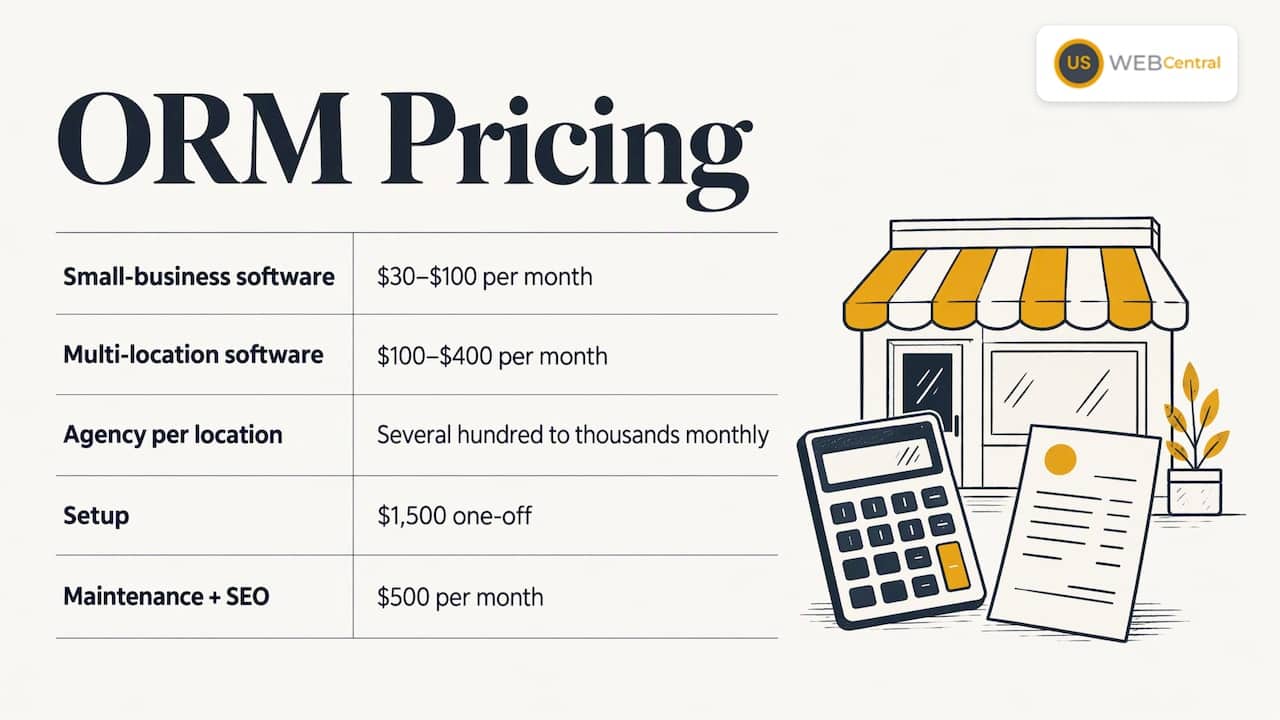
Prices vary with the scope. ReviewsGauge’s 2026 pricing breakdown puts small business review management software at $30 to $100 a month, multi-location software at $100 to $400 a month, and done-for-you agency work at several hundred to several thousand dollars a month per location. The four main price drivers it names are the number of locations, review sources, reply drafting and account assignment.
The practical lesson: pay for what your business uses. A single-location contractor rarely needs enterprise features. A clinic with several providers may value reply drafting and a clear process more than dashboards.
Our approach folds reputation work into local SEO instead of selling it separately. Setup is $1,500 one-off, and the monthly maintenance and SEO plan is $500 per month, as published on our pricing page.
Our perspective
Most local owners treat reputation as something that happens to them: a review shows up, they react. We see it differently. Your reputation is made of signals that all have to agree: reviews, your Google Business Profile, citations, your website, and what AI tools say about you.
That is why we do not treat ORM as a separate product. When your website content matches your Google Business Profile, your listings carry the same name, address and phone number everywhere, and fresh content explains what you do and where, Google and AI platforms have a clean story to tell. Reviews then reinforce it instead of fighting it.
Our Lumina package is built on that idea: a custom website plus a 12-month local SEO plan covering Google, Maps and AI platforms, with Google Business Profile work, citations and monthly content. We have built more than 1,000 sites since 2005, and one HVAC company reported nearly tripling its website visits after optimization. Our work is aimed at real calls and leads, not just prettier pages.
Scott Carvin
Where Lumina fits
If you want the foundation handled for you, Lumina combines a custom WordPress website with a 12-month local SEO plan. It includes Google Business Profile setup and management, citation and NAP consistency, monthly AI-ready content, and technical audits. We work directly with the implementation team on your project, so you are not passed between departments.
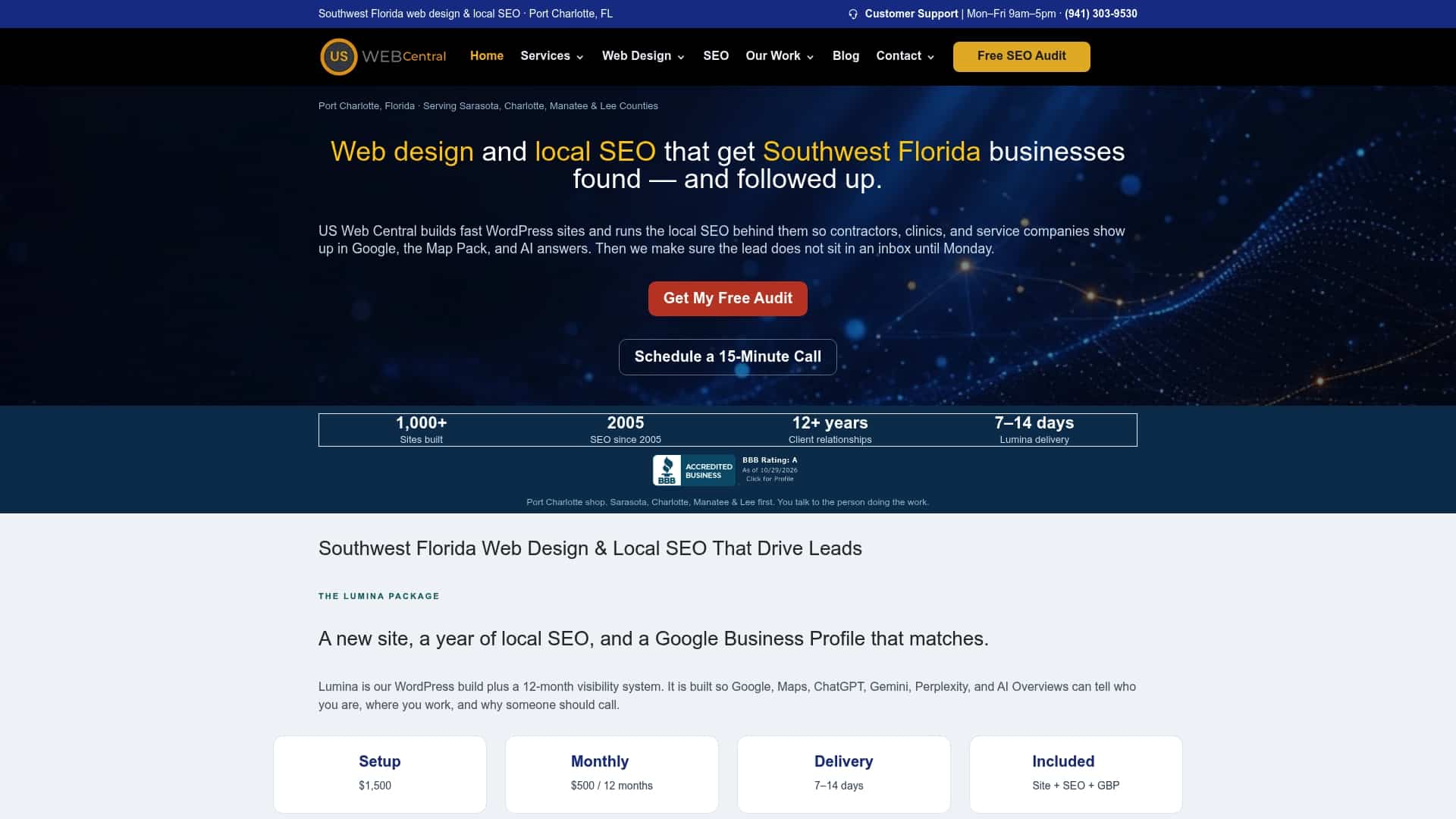
The setup fee is $1,500 one-off and the monthly maintenance and SEO plan is $500 per month. Premium SEO hosting is $250 per year. Details are on our Lumina pricing and availability page, and you can see how the work plays out in our Sarasota HVAC case study. Want to know where you stand first? Start with the AI visibility audit and see what Google, Maps and AI tools currently show for your business.
A 30-day starting plan
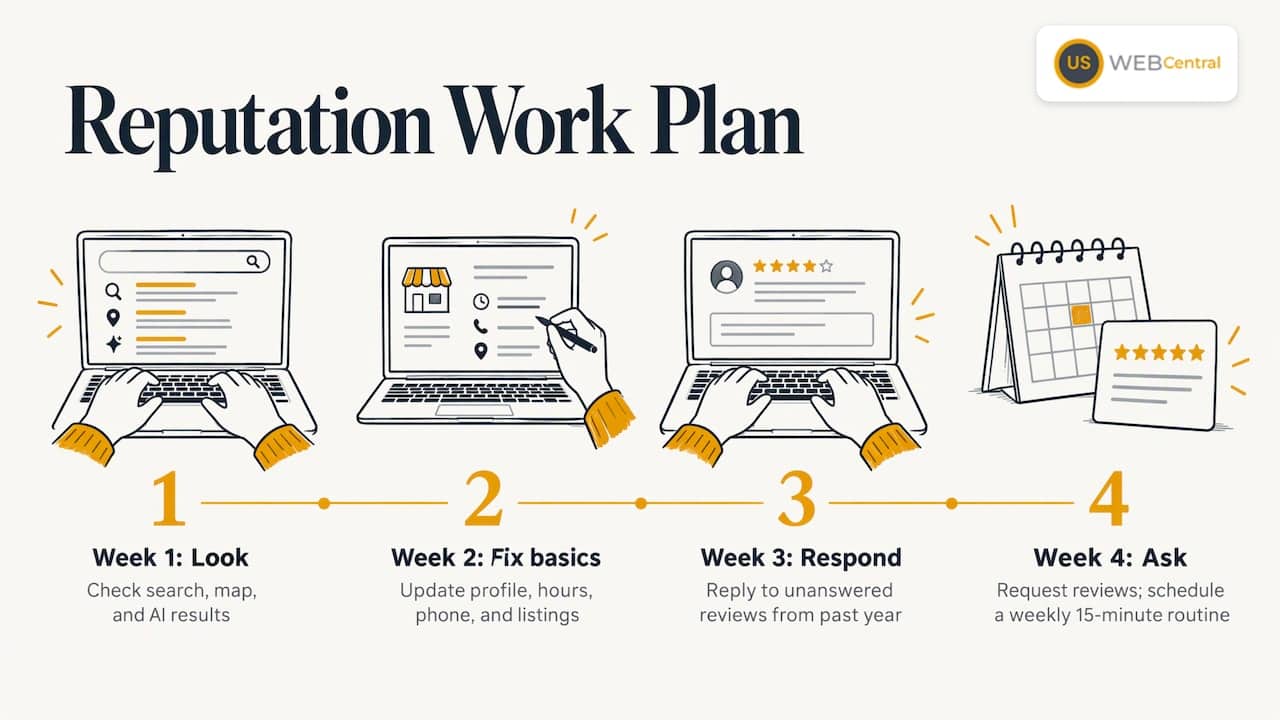
Week 1: look. Search your business name in a private window. Screenshot the first page, the map listing and any AI answer. Note any wrong information.
Week 2: fix the basics. Complete your Google Business Profile, correct your hours and phone number, and claim your main directory listings.
Week 3: respond. Reply to every unanswered review from the past year. For a clinic, use generic, privacy-safe language approved by your compliance contact.
Week 4: ask. Add a review request to your close-out routine, with a direct link. Set a weekly 15-minute calendar block to repeat the cycle.
FAQ
How much does online reputation management cost?
It depends on scope. Review management software for small businesses runs about $30 to $100 a month, and done-for-you agency services run from several hundred to several thousand dollars a month per location, according to ReviewsGauge. Locations, review sources and reply drafting drive the price.
Can I respond to a patient’s negative review?
Yes, but only in generalities. Do not confirm the person is a patient or mention any detail of their care, since that can violate HIPAA. Invite them to call your office, and ask your compliance contact to approve your templates.
How often should I check my reviews?
Weekly for new reviews on Google, Yelp and industry platforms, and monthly for a search of your business name, as Xero recommends. Fast replies matter, so many businesses also turn on email alerts for new reviews.
Is reputation management the same as SEO?
They overlap but are not identical. SEO helps people find you, while ORM shapes what they see and believe when they do. For local businesses, Google Business Profile, citations, website content and reviews feed both, which is why we handle them together through local SEO services.
Sources
- Online reputation management: The Ultimate Guide, Forbes Advisor
- A Beginner’s Guide to Online Reputation Management, Semrush
- What Is Online Reputation Management? StatusLabs
- Online reputation management guide for small businesses, Xero
- BBB Business Tip: How to handle negative reviews
- 5 Steps for Powerful Small Business Reputation Management, ReviewTrackers
- What is online reputation management? Brandwatch
- The Reputation Stack: Monitoring, Removal, and Suppression, Meldium
- What is Online Reputation Management, Birdeye
- Local Business Reputation Management (2026), Flento
- FTC final rule banning fake reviews and testimonials
- Protect your practice’s reputation, American Dental Association
- Reputation Management, Texas Medical Liability Trust via HCMS
- Medical practice reputation management: A HIPAA-safe guide, Pabau
- Reputation Management Cost: Real 2026 Pricing, ReviewsGauge