

To respond to a negative review, reply publicly within a day or two. Stay calm, thank the reviewer, own what is true, and keep it short. Then move the details to a phone call or email. Write the reply for the next customer who reads it, not for the person who is angry. That is how you handle a bad Google review without making it worse.
Below you will find the method we use with local service businesses in Southwest Florida. You will also find reply templates for contractors and clinics, and a plain answer on when a review can be reported instead of answered.
Key takeaways
- A reply is public. The reviewer reads it, but so does every future customer comparing you with the next company on the map.
- Answer fast, but not instantly. Aim for the same day or the next, and write something specific to that review.
- Stick to facts, never argue, and move complex problems to a private phone call or email.
- Clinics must never confirm that a reviewer is a patient or share any detail about their care.
- Reviews that break Google’s content policies can be flagged for removal. Reviews you simply dislike cannot.
Table of Contents
- Why a reply matters more than the review
- Before you type a word
- A five-part structure for any negative review
- Reply templates for local service businesses
- How fast should you reply?
- Take it offline, and do it for real
- What not to do
- When a review should be reported, not answered
- Our perspective: replies are part of your local SEO
- Make your profile ready for the next review
- A simple monthly review routine
- FAQ
- Sources
Why a reply matters more than the review
You cannot control whether a customer posts a one-star review. You fully control what the page looks like afterward. A prospective customer scanning your profile will often read the worst reviews first, then look at how you handled them.
Recency matters too. The Better Business Bureau reports that over 80 percent of people consider reviews older than three months irrelevant, and about 60 percent of 18 to 34-year-olds look only at reviews from the past two weeks. A calm, professional reply to a fresh complaint is part of your current reputation, not a footnote.
There is a quieter benefit as well. Google’s own community guidance notes that a few negative reviews can build credibility, because a perfect 5-star record can look inauthentic. A handled complaint shows a real business with real standards.
Reviews also shape the local picture Google builds of you. We cover that in how Google reviews decide the call in Southwest Florida.
Before you type a word
Most bad replies are written in the first ten minutes after reading the review. Build a short pause into your routine.
- Read it twice, then walk away. Wait an hour if you are angry. Not instantly, not next week.
- Find the job. Pull the work order, estimate, invoice, call notes or crew schedule. Reply with informed confidence rather than guessing what happened.
- Decide who owns replies. The BBB advises assigning one specific staff member to monitor and respond to all reviews, so tone and messaging stay consistent. In a small shop that is usually the owner or office manager, not whoever happens to be near the computer.
- Sort the review. Is it a fair complaint, a misunderstanding, a review about a different business, or a policy violation? Each gets a different response.
- Decide the fix first. Know what you are willing to do (return visit, partial credit, a call from the owner) before you promise anything.
A five-part structure for any negative review
Good replies share the same bones. Keep them to roughly three or four sentences.
- Thank them by name. “Thank you for the feedback, Maria.” Plain and short.
- Acknowledge the specific problem. Name what went wrong: the missed arrival window, the cold exam room, the water stain. This shows you read it.
- Own what is yours. If you made a mistake, say so once, without excuses. If you did not, say you are sorry the experience fell short and state the facts calmly.
- State the next step. Give a direct phone number or email, and a name.
- Stop. Do not add a sales line, a list of your awards or a rebuttal paragraph.
The BBB’s guidance is to stick to facts and data and stay away from emotions, personalities or personal attacks. That rule settles most hard calls. If a sentence defends your pride instead of describing what happened, cut it.
Reply templates for local service businesses
Treat these as starting points. Change the details every time. The BBB warns that canned, one-size-fits-all responses read as impersonal, and other readers will suspect you will give them the same non-specific answer.
A contractor or HVAC company, late arrival
Thank you for telling us, Dan. You were given a Tuesday morning window and our technician arrived after noon. That is not the standard we set, and you should have gotten a call when the schedule slipped. Our service manager, Lisa, would like to hear more and make this right. Please call her at (941) 555-0100.
Why it works: it names the failure, accepts the part that is true, and gives a person and a number.
A plumber, disputed price
Thanks for the review, Carlos. Price surprises are frustrating, and we want to walk through the invoice with you. The quote we gave on the phone covered the repair, and the final bill also included the shutoff valve we replaced on site. Please call our office at (941) 555-0100 so we can go over every line together.
Why it works: it states facts without accusing, and it invites a private conversation instead of a public argument.
A review that is unfair
Thank you for the feedback. We have looked for your job in our records under the name and address you provided and cannot find a match. We would like to help, so please contact us at the number below with the date of service.
Why it works: it gives readers the context without attacking the reviewer. A neutral tone is what makes the unfair review look unfair.
A clinic or medical practice
Healthcare is different. Under HIPAA, even a friendly reply can be a problem. A Bass, Berry & Sims analysis explains that a response confirming or implying the reviewer’s status as a patient can itself be a violation, and that disclosing protected health information can trigger breach notification duties. Google’s guidance is consistent: never share a reviewer’s private information in a public response.
So a safe clinic reply says nothing about treatment, appointments, billing or whether the person was ever seen:
Thank you for sharing your feedback. We take every concern about the patient experience seriously. Because of privacy rules we cannot discuss any individual’s care in a public forum, but we would welcome a conversation. Please contact our practice manager at (941) 555-0100.
For your own compliance questions, ask your healthcare attorney or compliance officer to approve your reply policy once, then follow it every time.
How fast should you reply?
Google does not publish a required response window, so this is judgment. Our recommendation for a local service business is the same day or the next business day. Fast enough to show you are paying attention, slow enough that you have checked the facts and cooled down.
Two practical notes. First, you must have a verified profile to reply at all. Google’s help page says that before you can reply to reviews, you must verify your business. Second, your reply may not appear immediately. The same page says replies usually take up to 10 minutes to publish but can sometimes take up to 30 days, so do not post the same reply again.
A reply posted within seconds can also look automated. Take the time to write one that sounds like a person.
Take it offline, and do it for real
A public reply starts the conversation. A private one ends it. For anything involving money, safety, damage or a long chain of events, move to the phone. Put a direct line and a name in the reply, then call the customer yourself.
When you reach them:
- Let them finish before you explain anything.
- Repeat the problem back in your own words.
- Offer a specific fix, only one you can deliver.
- Confirm the outcome in writing afterward.
If they are satisfied, it is fine to politely ask whether they would update their review. Do not ask them to delete it, and never offer anything in exchange. Let them choose. Whether or not they edit, you can add a short follow-up reply, such as “We appreciate Dan taking our call and are glad we could resolve this.”
What not to do
- Do not argue. You may win the point and lose the reader.
- Do not reveal private details. Names, addresses, job details and anything medical stay out of public replies.
- Do not blame the customer. Even when it is partly their doing, say what you will do differently or state the policy neutrally.
- Do not copy and paste. Readers notice a repeated reply.
- Do not offer incentives for a changed review. It can violate Google’s policies and damages trust.
- Do not ignore a one-star review that has no text. A short, courteous reply asking them to call shows you are paying attention.
When a review should be reported, not answered
Some reviews are not feedback. Under the federal Consumer Review Fairness Act, according to the BBB, customers have a protected right to leave honest reviews, but that protection does not extend to content that is abusive, vulgar or threatening.
Google’s help page says that if you believe a review violates its content policies, you can flag it. Typical grounds are harassment, hate speech, explicit content, spam, or a review of the wrong business. A review that is harsh, unfair or from someone you feel was a bad customer is usually not removable. In that case, a professional reply is your only tool, and a good one.
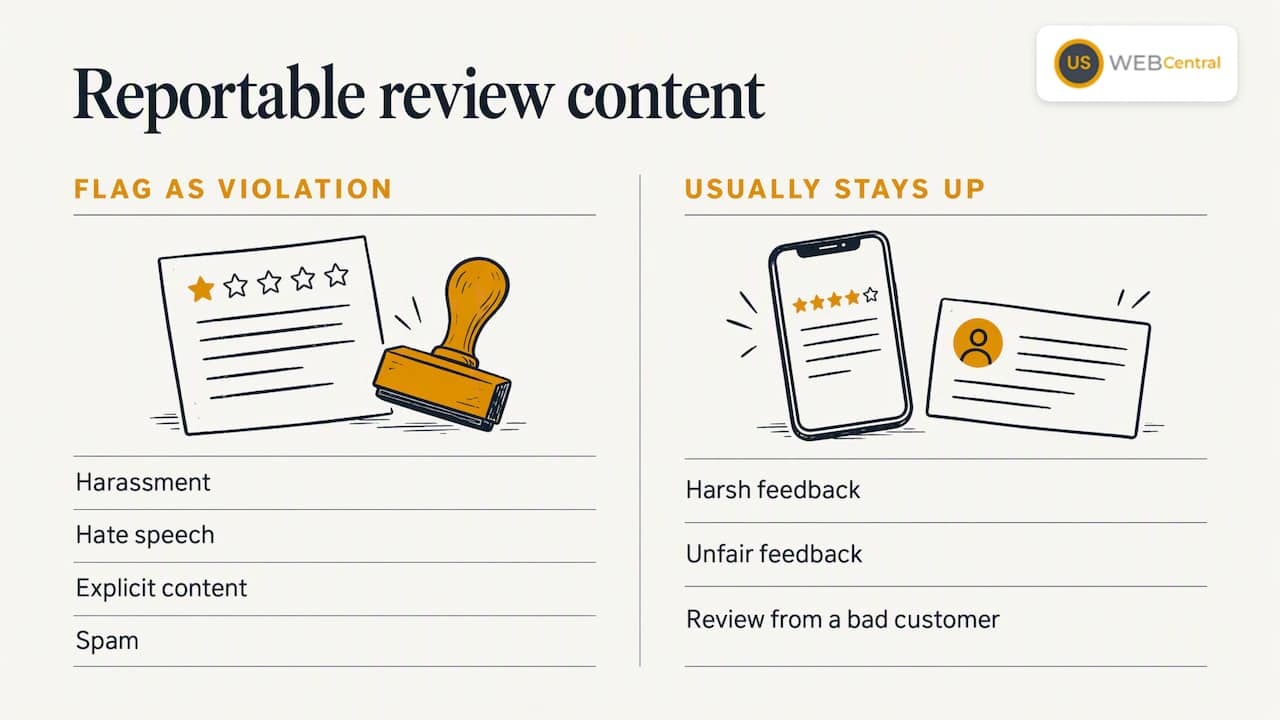
A workable routine: flag the policy violation, reply publicly only if the review stays up, and keep screenshots with dates in case you need to follow up. If you suspect a pattern of fake reviews or are being threatened, speak with an attorney.
Our perspective: replies are part of your local SEO
We build WordPress websites and run local SEO for contractors, clinics and service companies across Sarasota, Port Charlotte, Punta Gorda, Fort Myers and nearby. After more than 1,000 sites since 2005, the pattern is consistent: owners treat review replies as customer service, when they are also part of how a business presents itself in Google, Maps and AI-driven recommendations.
Here is what we tell clients. Your reviews, your Google Business Profile and your website should tell the same story. If a customer complains about scheduling, and your site and profile clearly state service hours, service areas and how to reach a dispatcher, the complaint reads as an outlier. If your profile is thin or inconsistent, the same complaint looks like the truth.
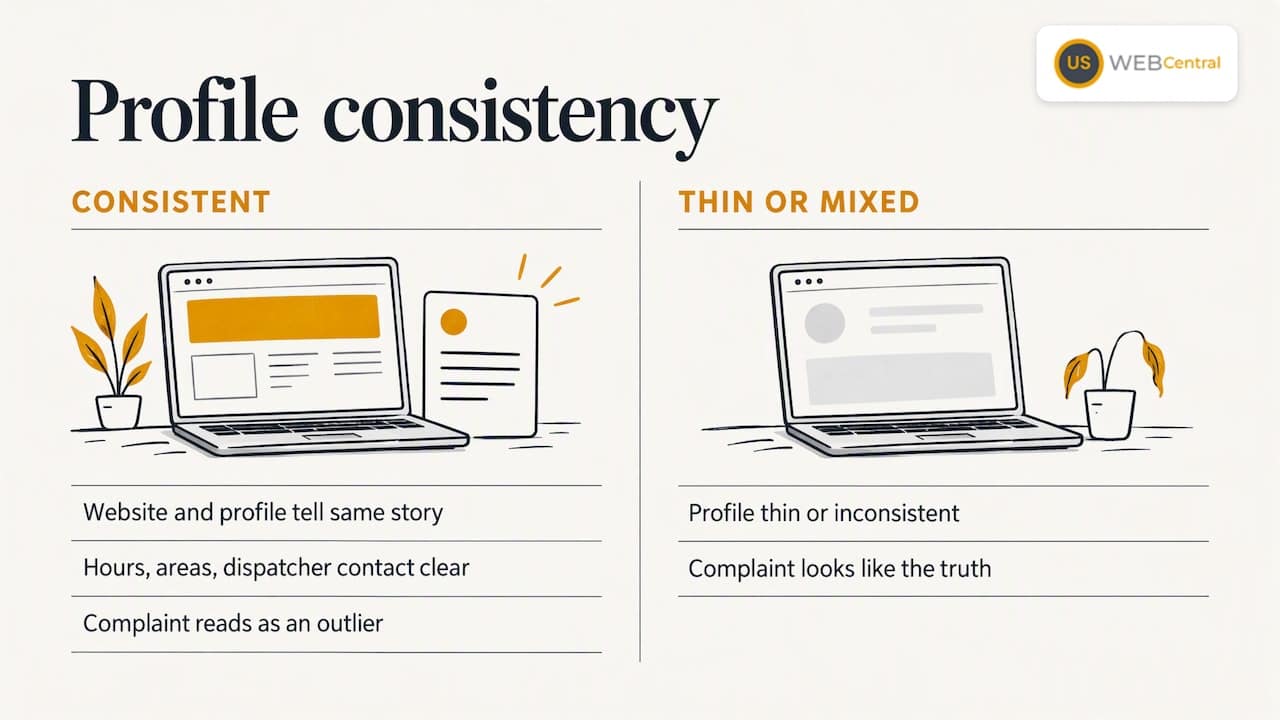
That is why we match website content to the Business Profile, and why reply discipline sits next to the technical work. We would rather you have 40 honest reviews with calm, specific replies than a spotless record that no one believes.
The cheapest improvement is to pick one person, set a same-day reply rule, and stop writing in anger. The rest is consistency.
— Scott Carvin
Make your profile ready for the next review
If a review is the first time you have looked at your profile in months, start there. We set up and manage Google Business Profiles as part of the Lumina package: a custom WordPress website with a 12-month local SEO plan that includes Business Profile setup, citations and NAP consistency, and monthly AI-ready content. Published pricing is a $1,500 one-off setup fee and $500 per month for maintenance and SEO. SEO hosting is $250 per year.
If you want to see where your profile and website stand first, request our AI Visibility Audit. You can also read about our Google Business Profile optimization work, or how an unmanaged profile costs you leads every day.
A simple monthly review routine
Replies work best as a habit.
| When | Task | Owner |
|---|---|---|
| Daily | Check for new reviews, enable email alerts | Office manager |
| Within 1 business day | Reply to every negative review using the five-part structure | Designated person |
| Within 2 business days | Call the customer and note the outcome | Owner or service manager |
| Weekly | Flag any policy-violating reviews | Designated person |
| Monthly | Look for repeat complaints (scheduling, pricing, communication) and fix the cause | Owner |
The last row is the one that changes your rating. Replies protect your reputation. Fixing the cause of repeat complaints lifts it.
FAQ
How do I reply to a bad Google review?
Open your verified Business Profile, select Read reviews, and choose Reply under the review. Thank the reviewer, acknowledge the specific issue, take responsibility for what is yours, and offer a private way to continue the conversation. Keep it to three or four sentences.
Should I respond to every negative review?
Yes, in nearly every case, including unfair ones, because future customers read the reply as much as the review. The exception is a review that violates Google’s content policies. Flag it, and reply only if it stays up.
Can I delete a negative Google review?
Not on your own. You can flag a review that breaks Google’s content policies, and Google decides whether to remove it. A review that is honest but harsh stays, and your best response is a calm, factual reply.
How should a clinic respond without violating patient privacy?
Never confirm the reviewer is a patient or mention any detail of their care, even in a positive reply. Use a general statement that you take feedback seriously and cannot discuss individual cases publicly, and invite them to contact your practice manager. Have your healthcare attorney approve your template.
Sources
- BBB Business Tip: How to handle negative reviews
- BBB Business Tip: Why responding to your customer reviews matters
- Google Business Profile Help: Manage customer reviews
- Google Business Profile Help: Tips to get more reviews
- Google Business Profile Community: How to effectively respond to Google reviews
- Bass, Berry & Sims: Responding to online patient reviews without violating HIPAA